Governed Autonomy Buyer Checklist
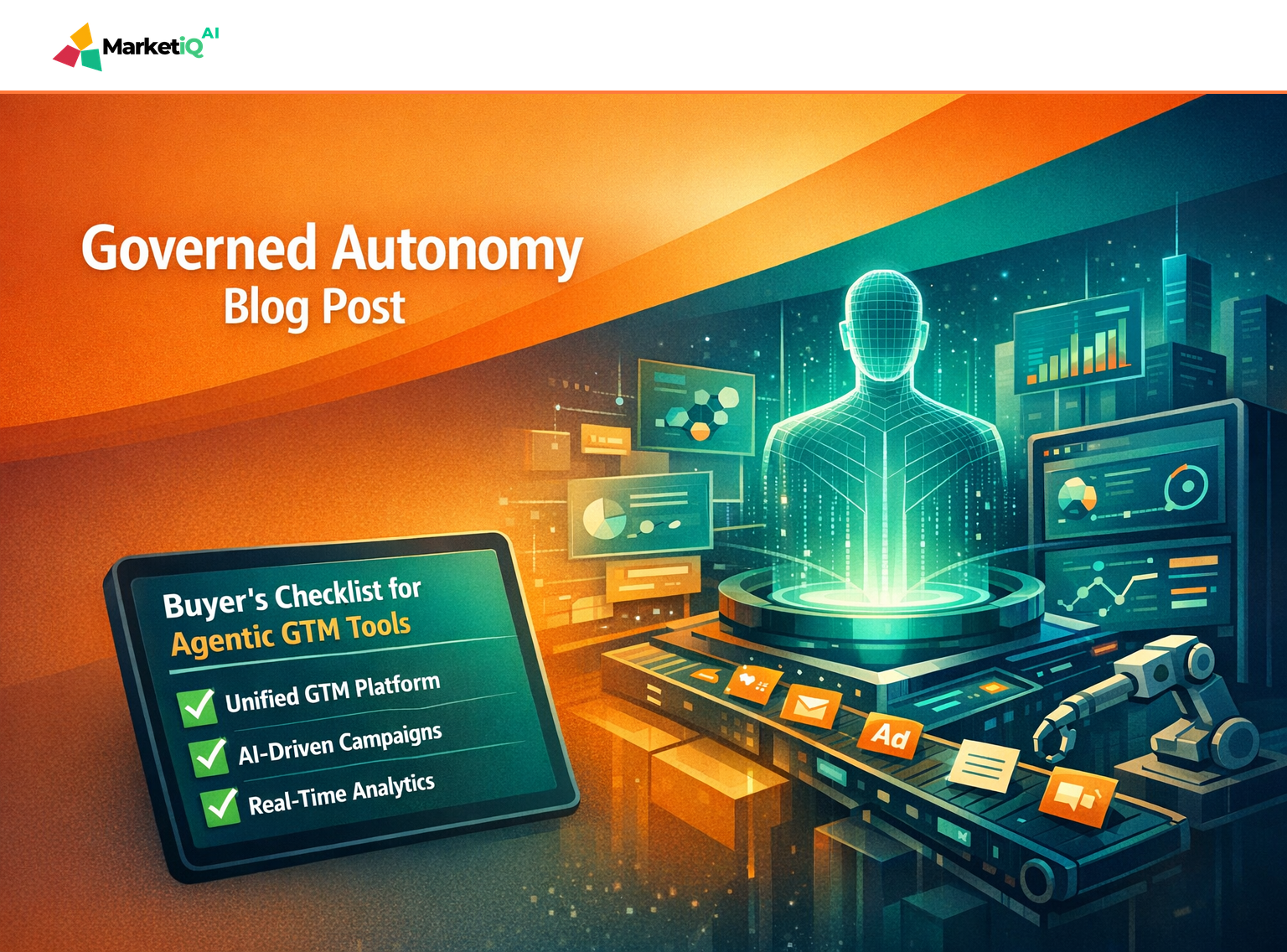
Governed Autonomy in Marketing: The Buyer’s Checklist for Agentic GTM Tools
Before you let AI touch campaigns, ads, outreach, or reporting, ask one question: can you see and control exactly what it is doing?
That question separates useful agentic AI marketing governance from blind automation.
MarketiQ is built around that distinction. It is not an AI marketing assistant, copy tool, scheduler, or isolated ad optimizer. MarketiQ is an autonomous go-to-market operating system led by an AI CMO, powered by 46 AI agents, 31 autonomous loops, 30+ modules, one shared revenue graph, and human-governed guardrails.
The goal is not to remove operators from GTM. The goal is to move operators out of repetitive execution and into control: strategy, approvals, risk decisions, and revenue judgment.
That matters because agentic GTM is moving beyond prompt-and-response workflows. Highspot describes agentic AI in GTM as replacing static reporting with predictive intelligence that continuously interprets the right data (https://www.highspot.com/go-to-market-guide/agentic-ai-gtm/). Tapistro frames an agentic GTM platform as more than task automation: it makes decisions, adapts to buyer behavior, and executes (https://www.tapistro.com/blog/agentic-gtm-or-rebranded-automation-six-tests-that-tell-the-difference).
If AI can decide and execute, governance can no longer be an afterthought.
Use this checklist to evaluate any autonomous GTM platform before it touches your brand, budget, CRM, ad accounts, outbound motions, or board reporting.
1. Approvals: Can humans control what ships?
The first test for AI marketing automation governance is simple: does the system ask for approval at the moments that matter?
A serious agentic GTM platform should support different approval rules for different actions. Drafting a LinkedIn post is not the same risk level as launching paid spend, emailing prospects, changing campaign budgets, or publishing a competitive comparison page.
In MarketiQ, governed autonomy means the AI CMO and specialized agents can research, plan, draft, score, and recommend actions autonomously, while publishing and higher-risk actions can be routed through approval workflows.
Your checklist:
- Can content be reviewed before publishing?
- Can ads be approved before launch?
- Can outbound sequences require human sign-off?
- Can different users approve different action types?
- Can approvals be required for budget, brand, legal, or compliance-sensitive work?
- Can you see what changed between draft, review, and final approval?
If a vendor only offers a global “autopilot on/off” switch, that is not governance. That is a liability disguised as simplicity.
The right model is tiered autonomy: low-risk tasks can move quickly, while high-risk actions require explicit human control.
2. Permissions and risk tiers: Can autonomy be scoped by role, channel, and impact?
Autonomous GTM guardrails should not treat every user, workspace, channel, and action the same.
A founder may want full visibility across strategy, pipeline, and spend. A content lead may only need control over blogs, social, and campaign assets. An agency operator may need access across client workspaces without exposing one client’s data to another. An enterprise team may require SSO, role-based access, audit trails, and stricter approval gates.
MarketiQ is designed for this operating reality. Its governed AI CMO does not sit above the business as an unmanaged black box. It runs inside workspace-level controls, brand rules, permissions, and risk tiers.
Your checklist:
- Can permissions be assigned by role?
- Can users be limited by workspace, client, brand, or business unit?
- Can actions be classified by risk level?
- Can paid media, CRM, outbound, analytics, and publishing access be separated?
- Can an admin restrict who can change models, budgets, integrations, or brand memory?
- Can risky workflows require additional review?
This is especially important for lean B2B SaaS teams. The same person may be handling positioning, content, lifecycle, paid tests, sales enablement, and investor updates. Without permissions and risk tiers, autonomous systems can turn one overloaded operator into a single point of failure.
The buyer question is not “Can this AI do more?”
The buyer question is “Can this AI do more only inside the boundaries we define?”
3. Audit trails and citations: Can you prove where every recommendation came from?
Agentic AI marketing governance breaks down when teams cannot explain why a system recommended a campaign, changed a message, prioritized an audience, or generated a report.
That is why auditability matters.
A governed GTM operating system should record what the system researched, what sources it used, what assumptions it made, what it created, who approved it, where it was published, and what happened next.
MarketiQ’s evidence-first strategy is built around this requirement. The platform is designed to ground GTM plans in sourced research, competitor analysis, audience-question mining, performance signals, timestamps, confidence scores, and honest gaps instead of fabricated certainty.
Your checklist:
- Does the system cite external sources when making market claims?
- Does it show timestamps for research and recommendations?
- Does it preserve edit history?
- Does it log which agent created or changed an asset?
- Does it connect campaign assets to outcomes in reporting?
- Does it distinguish sourced claims from AI-generated interpretation?
- Can leadership inspect the chain from research to campaign to revenue impact?
This is where MarketiQ’s revenue graph matters. Fragmented GTM stacks split research, content, ads, outreach, CRM, analytics, and reporting into separate systems. That makes learning fragile. One tool writes the blog. Another launches the ad. Another logs the lead. Another reports attribution. The strategic memory disappears between tabs.
MarketiQ connects those workflows inside one operating layer so the system can learn from the full loop: research, strategy, creation, publishing, ads, attribution, and optimization.
Governance is not just about preventing bad actions. It is also about making good actions explainable.
4. Model controls, cost limits, and kill-switches: Can you stop, cap, or change the system?
If a platform uses agentic AI but does not let you control models, spend, and execution limits, it is not ready for serious GTM work.
Marketing teams need practical controls:
- Which models can be used?
- Which workflows can run autonomously?
- How much can the system spend?
- How often can agents run?
- What happens when confidence is low?
- Can a human stop all automation immediately?
MarketiQ’s governed autonomy posture includes model selection, cost limits, compliance checks, kill-switches, and human override. That matters because a real autonomous GTM operating system is not generating one-off copy. It may be coordinating campaign briefs, SEO pages, ads, social posts, email sequences, audience research, reporting, and optimization recommendations across multiple channels.
Your checklist:
- Can admins set cost ceilings?
- Can specific loops be paused without shutting down the whole workspace?
- Can the system escalate instead of acting when uncertainty is high?
- Can humans override recommendations?
- Can agents be restricted from certain channels or datasets?
- Can autonomous optimization be separated from autonomous publishing?
- Is there a visible kill-switch for urgent intervention?
This is the difference between governed autonomy and reckless automation.
The best autonomous GTM systems should feel like a high-output operating team with controls, not a runaway script with a nicer interface.
5. Workspace memory and data boundaries: Can the AI learn without leaking context?
Agentic systems become more valuable when they learn from your market, customers, campaigns, and revenue outcomes. But that learning must be bounded.
A GTM platform should remember your ICP, positioning, offers, objections, product language, brand rules, content performance, CRM patterns, channel learnings, and campaign history. It should not force every campaign to start from zero. That is the core advantage of moving from disconnected tools to one autonomous GTM operating system.
But memory without boundaries creates risk.
MarketiQ’s Brand Brain and workspace memory are designed to keep tone, messaging, assets, campaign context, and performance learnings available inside the right workspace. Its revenue graph lets learnings compound across modules while maintaining control over what data the AI can access and act on.
Your checklist:
- Can brand memory be edited and governed?
- Can incorrect assumptions be removed?
- Can workspaces be separated by company, product, region, or client?
- Can admins define which data sources agents may use?
- Can sensitive information be excluded from generation workflows?
- Can the system learn from performance without exposing private context elsewhere?
- Can teams inspect what the AI “knows” about the brand and ICP?
This is especially important for agencies, enterprise teams, and multi-product companies. Autonomous GTM only works if memory compounds safely.
A copy tool can produce another asset. A governed GTM operating system should build institutional memory.
The buyer’s final test: Is this a tool, or an operating system?
Most AI marketing products still fit into familiar point-solution categories:
- AI copywriting assistant
- Social scheduler
- SEO brief generator
- Ad creative tool
- Outreach automation tool
- Analytics dashboard
- Reporting assistant
Those tools may save time inside one workflow. But they do not solve the larger GTM problem: strategy, execution, attribution, optimization, and learning remain scattered.
MarketiQ is built for a different operating model. The AI CMO coordinates 46 specialized agents across 31 autonomous loops and 30+ modules, with shared memory, one revenue graph, sourced research, approval workflows, audit trails, model controls, cost limits, and human override.
That is the standard buyers should use when evaluating agentic AI marketing governance.
Do not ask only whether the system can generate campaigns.
Ask whether it can govern the full campaign lifecycle:
- Research with sources
- Plan with strategy context
- Create on-brand assets
- Route approvals by risk
- Publish only within permissions
- Optimize within cost limits
- Attribute outcomes to pipeline and revenue
- Learn without losing auditability
- Stop immediately when humans intervene
Autonomy is only useful when control scales with it.
If you are evaluating agentic GTM tools for a lean SaaS team, growth team, agency, or revenue organization, book a MarketiQ governance-focused product walkthrough and see how 46 AI agents run full-funnel GTM loops under approvals, audit trails, cost controls, and human override.
- #Governed
- #Autonomy
- #Marketing
- #Buyers
- #AgenticAI
- #GTM
- #MarketiQ
This article describes practices and observations; it is not a promise of rankings, deliverability or revenue. Verify cited sources and their dates before making decisions.
Related reading
- 1MarketiQ vs Clay comparisonLinked from this article
- 2Stop Rebuilding Campaign Briefs From ScratchLinked from this article
- 3MarketiQ vs Jasper AI ComparisonLinked from this article