MarketiQ vs Jasper AI Comparison
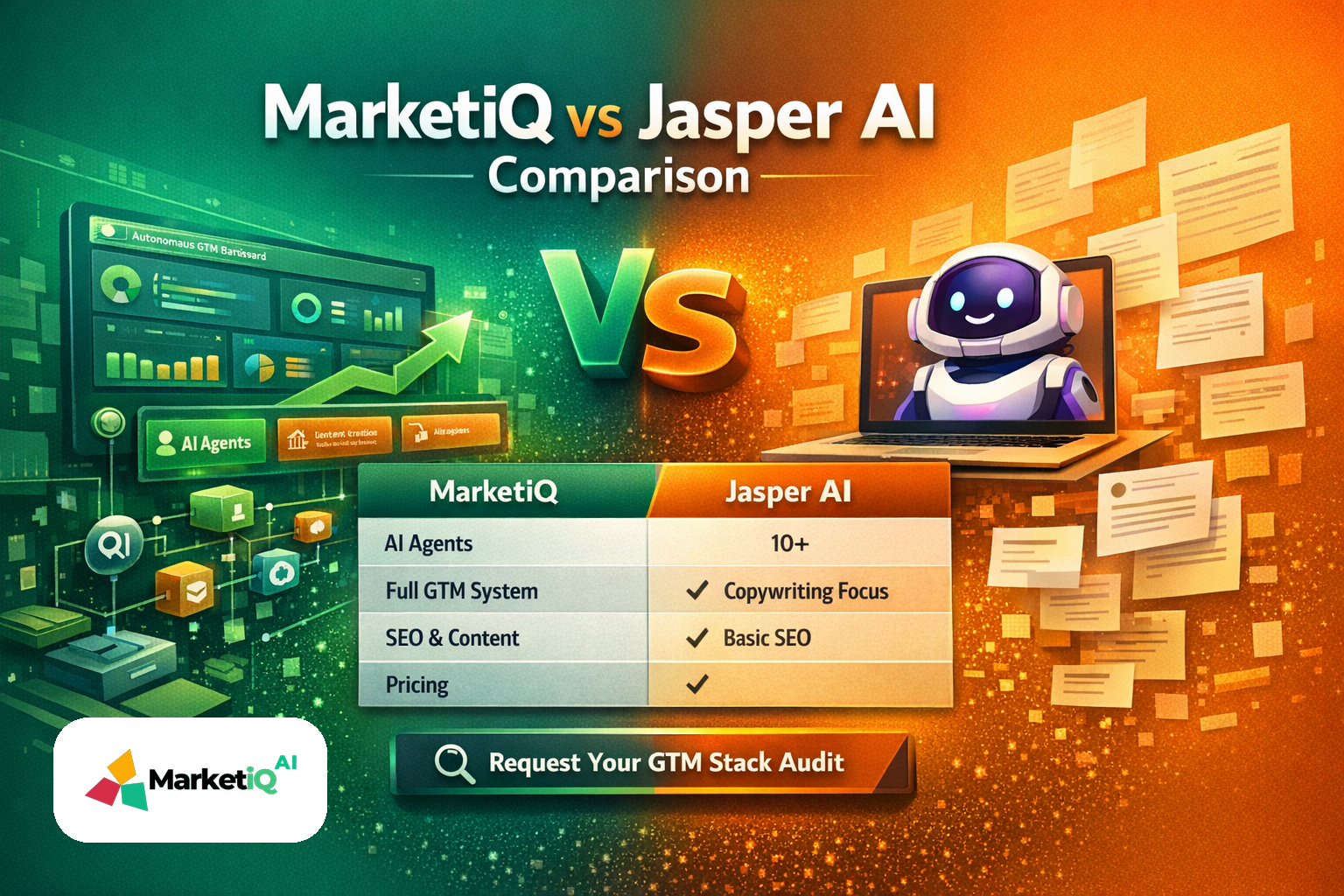
MarketiQ vs Jasper AI: Features, Pricing & ROI
AI writing tools generate copy. Autonomous GTM systems execute revenue workflows.
That is the core difference in the MarketiQ vs Jasper AI comparison.
Jasper AI is built for teams that need faster, on-brand writing. MarketiQ is built for lean SaaS teams that need a governed go-to-market engine: research, strategy, content, publishing, ads, attribution, optimization, and learning in one operating system.
If your only bottleneck is copy production, Jasper may be enough. If your bottleneck is turning strategy into pipeline across channels without hiring a full marketing team or stitching together 8–10 tools, MarketiQ is the deeper fit.
MarketiQ vs Jasper AI at a Glance
| Category | MarketiQ | Jasper AI |
|---|---|---|
| Core category | Autonomous GTM operating system | AI writing and brand content platform |
| Primary job | Execute full-funnel GTM workflows | Create and adapt marketing copy |
| Automation depth | 45 AI agents and 26 optimization loops | Prompt, template, and campaign-based content generation |
| Workflow coverage | Research, strategy, content, ads, publishing, reporting, attribution, optimization | Blog posts, ads, emails, landing page copy, brand voice content |
| Governance | Approvals, guardrails, auditability, human-controlled autonomy | Brand voice and collaboration controls |
| Revenue learning | Campaign and performance feedback loops | Content workflow improvement, not full-funnel attribution |
| Best for | Seed-Series B SaaS teams replacing fragmented GTM execution | Marketing teams scaling content production |
The short version: Jasper helps marketers write faster. MarketiQ helps lean teams operate a revenue workflow with AI agents under human governance.
Key Features Compared
Jasper’s strength is content creation. It helps teams generate copy, maintain brand voice, repurpose assets, and move faster across common marketing formats. For teams with a working GTM system already in place, this can be valuable.
MarketiQ starts earlier and goes further. Its AI CMO-led system is designed to research the market, map ICPs, generate campaign strategy, produce assets, publish across channels, monitor outcomes, and feed results back into future decisions.
That matters because most lean SaaS teams do not have a writing problem in isolation. They have an execution system problem:
- Positioning lives in one doc.
- CRM data lives somewhere else.
- Ads are optimized in another tab.
- Content calendars are manually maintained.
- Attribution is checked after the campaign is already stale.
- Reporting takes hours of copy-paste work.
MarketiQ is built to consolidate that motion. Its 45 agents and 26 loops are designed around GTM jobs, not just content jobs: campaign planning, SEO research, paid creative, publishing, optimization, reporting, and revenue learning.
Content Quality and SEO Performance
For pure writing quality, Jasper is a mature AI content platform. It is useful for drafting blogs, ads, emails, landing pages, social captions, and brand-consistent copy. If you already know the campaign, audience, keyword strategy, channel mix, and performance targets, Jasper can help produce assets quickly.
MarketiQ’s content engine is tied to a broader evidence layer. Instead of treating content as a standalone deliverable, it connects content decisions to ICP research, competitor signals, audience questions, campaign goals, and downstream performance.
That changes the SEO workflow.
A Jasper-led SEO process often looks like this: choose keyword, generate brief or draft, edit, publish through another system, track results elsewhere.
A MarketiQ-led SEO workflow is designed to connect the loop: research the opportunity, generate the brief, create the asset, align it to the brand and funnel stage, publish through the GTM workflow, monitor performance, and use results to improve the next campaign.
For teams trying to build compounding organic demand, the difference is not just the quality of one article. It is whether every asset teaches the system what to do next.
Ease of Use, User Experience, Pricing and Value for Money
Jasper is relatively straightforward for content teams because the mental model is familiar: select a use case, provide context, generate copy, refine, and collaborate. It fits well inside existing workflows.
MarketiQ requires a different expectation. It is not just a writing surface. It is closer to a GTM cockpit. The value comes from connecting brand, customer, campaign, channel, and performance context so the system can execute more of the operating loop.
On pricing, Jasper typically makes sense as a content productivity line item. The ROI case is time saved on writing, repurposing, and brand adaptation.
MarketiQ’s value case is stack replacement and execution leverage. It is free to start, with paid value tied to replacing disconnected tools and manual GTM labor across research, content, ads, publishing, reporting, and optimization.
For a Seed-Series B SaaS team, the better question is not “Which tool is cheaper?” It is:
- How many tools can this replace?
- How many hours of manual campaign work disappear?
- How much faster can we launch experiments?
- Can we connect activity to pipeline?
- Can the system learn from our actual performance data?
If you only replace a copywriting tool, Jasper may be the simpler spend. If you replace a stack of writing, planning, scheduling, reporting, and optimization workflows, MarketiQ has the stronger ROI ceiling.
Use Cases and Best Fit: Pros and Cons of Each Platform
Jasper is best when your team already has a marketing strategy, channel owners, analytics process, and publishing workflow. It gives those people more content velocity.
Jasper pros:
- Strong AI writing workflows
- Useful brand voice features
- Good fit for content teams and copy-heavy campaigns
- Easy to adopt without changing the full GTM stack
Jasper cons:
- Does not function as a full autonomous GTM operating system
- Requires separate tools for publishing, attribution, ads, CRM, and optimization
- ROI is mostly tied to content production efficiency
- Limited ability to coordinate full-funnel execution on its own
MarketiQ is best for lean SaaS teams that need the equivalent of a coordinated GTM function without hiring a full marketing org.
MarketiQ pros:
- Full-funnel GTM execution, not just content generation
- 45 AI agents and 26 optimization loops
- Built for research, strategy, content, publishing, ads, reporting, and learning
- Strong fit for stack consolidation and lean-team leverage
- Governed autonomy with approvals, guardrails, and human control
MarketiQ cons:
- Broader system requires more strategic onboarding than a simple writing tool
- Best value appears when teams connect enough GTM data and workflows
- Category-new buyers should evaluate fit through a stack audit or pilot workflow
Which AI Writing Tool Should You Choose?
If you are comparing MarketiQ vs Jasper AI as writing tools only, Jasper is the more conventional answer. It is built to help marketers generate and refine copy.
But if you are a founder, Head of Marketing, or growth lead at a lean B2B SaaS company, the real question is bigger than writing.
You are likely trying to answer:
- What should we say?
- Which audience should we prioritize?
- Which channels deserve budget?
- What campaigns should ship this week?
- Which assets are driving qualified pipeline?
- What should we stop, scale, or test next?
That is where MarketiQ is materially different. It is not another AI copy assistant. It is an autonomous go-to-market operating system built to execute under human-governed guardrails.
Choose Jasper if your GTM engine is already working and your main gap is content velocity.
Choose MarketiQ if your team needs to replace fragmented tools, launch campaigns faster, connect execution to performance, and build a GTM system that learns from every cycle.
Want to know what MarketiQ could replace in your current stack? Request a GTM stack audit and see which workflows, tools, and manual handoffs can be consolidated into one autonomous operating system.
- #MarketiQ
- #Jasper
- #AI
- #Features
- #Pricing
- #GTM
- #MarketingAutomation
- #RevenueOperations
This article describes practices and observations; it is not a promise of rankings, deliverability or revenue. Verify cited sources and their dates before making decisions.
Related reading
- 1MarketiQ vs Clay comparisonLinked from this article
- 2Stop Rebuilding Campaign Briefs From ScratchLinked from this article
- 3Governed Autonomy Buyer ChecklistLinked from this article