MarketiQ vs HubSpot Lean SaaS GTM Comparison
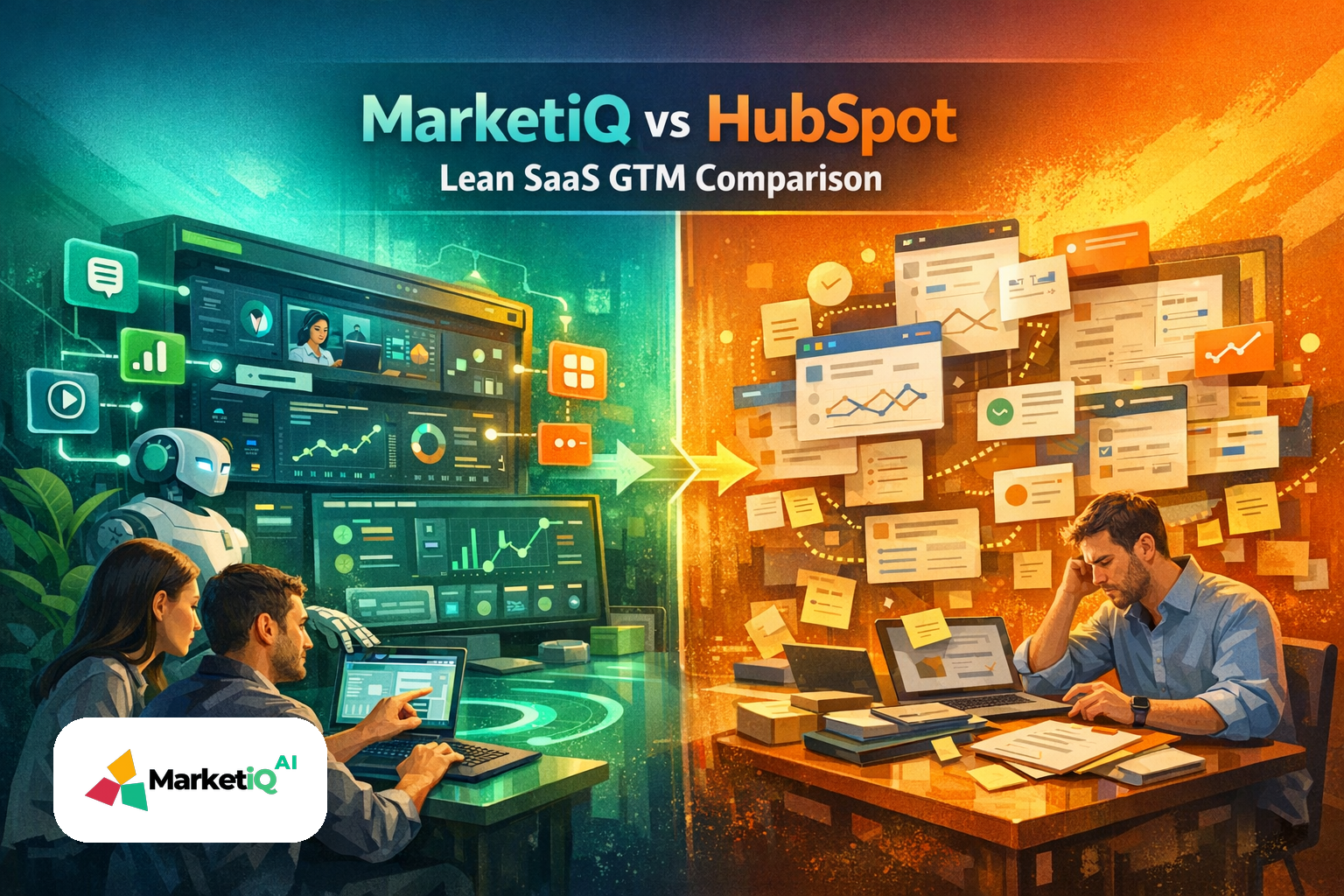
MarketiQ vs HubSpot for Lean SaaS GTM
If you are a 12-person SaaS company choosing between HubSpot and MarketiQ, the real question is not “Which tool has more features?” It is: do you need another CRM-centered system to administer, or an autonomous GTM execution layer that can turn your website, CRM data, positioning, and performance signals into campaigns?
HubSpot is a strong CRM and marketing automation suite. MarketiQ is built for a different job: running the full GTM loop with an AI CMO, 46 AI agents, and 31 autonomous loops across research, strategy, content, publishing, ads, attribution, and learning.
For lean SaaS teams with no RevOps hire, that difference matters.
MarketiQ vs HubSpot: Quick Comparison for Lean SaaS Teams
| Category | HubSpot | MarketiQ |
|---|---|---|
| Core role | CRM, contact database, workflows, reporting, sales/marketing hub | Autonomous go-to-market operating system |
| Best at | Managing contacts, pipeline, email workflows, forms, reporting, ecosystem integrations | Researching, planning, creating, publishing, optimizing, and learning from campaigns |
| Operating model | Human-configured automation | AI CMO-led autonomous orchestration under guardrails |
| Team need | Admin/operator required to build and maintain campaigns | Designed for lean teams that need execution capacity without adding headcount |
| Source of truth | CRM-centered customer and contact records | Revenue graph connecting brand, ICP, campaigns, content, channels, and performance |
| Governance | Permissions, workflow controls, CRM administration | Approvals, audit trails, risk tiers, model governance, kill-switches |
A fair comparison starts here: HubSpot is not “bad” because it requires human operators. It is powerful because of its CRM foundation and ecosystem. But if your bottleneck is campaign velocity, not contact storage, you may need a different layer.
How Lean SaaS GTM Teams Evaluate Marketing Platforms
A Seed or Series A SaaS team usually does not have a full marketing org. One founder, a Head of Marketing, or a growth lead is expected to handle positioning, landing pages, LinkedIn posts, outbound support, paid tests, email, SEO, reporting, and board-ready pipeline analysis.
That team should evaluate platforms on five questions:
- How fast can we launch a complete campaign?
- How much human setup is required before value appears?
- Does the system learn from performance data?
- Can it consolidate tools without creating a new admin burden?
- Can we prove pipeline impact, not just activity?
HubSpot helps organize the customer system. MarketiQ helps operate the GTM system. Lean teams often need both categories of capability, but they should not confuse them.
CRM, Pipeline Attribution, and Source of Truth
HubSpot’s biggest strength is its CRM layer: contacts, companies, deals, lifecycle stages, sales activity, forms, email engagement, and reporting. For SaaS teams that need a clean contact database and sales-marketing handoff, HubSpot is a proven center of gravity.
The limit is that CRM data does not automatically become strategy. A contact record will not decide which ICP pain to attack this week. A pipeline report will not write the campaign brief, generate channel assets, publish variations, reallocate budget, or document what the team learned.
MarketiQ is designed around a revenue graph: one shared layer for brand, ICP, campaigns, channels, performance, and attribution. Instead of treating reporting as the end of the workflow, MarketiQ uses performance signals as input for the next GTM loop.
That makes the distinction simple:
- HubSpot is strong as a CRM source of truth.
- MarketiQ is built as an execution and learning source of truth.
For teams already using a CRM, MarketiQ does not need to replace the CRM record. It can use CRM and website inputs to decide what the GTM system should build next.
Marketing Automation and Lifecycle Execution
HubSpot workflows are useful for lifecycle automation: lead routing, nurture sequences, form follow-ups, list segmentation, sales notifications, and customer journeys. If your team already knows what should happen, HubSpot can help automate the steps.
But workflows still need human planning. Someone must define the audience, map the journey, write the emails, build the landing page, create ads, coordinate content, QA the logic, review reporting, and decide what to change.
MarketiQ is designed for the layer before and after automation:
- research the market and competitors
- identify ICP pains and buying triggers
- create campaign strategy
- generate on-brand content and ads
- publish under approval rules
- monitor performance
- recommend or execute optimizations
- feed outcomes back into workspace memory
This is where autonomous orchestration matters. Lean teams do not need a blank automation canvas. They need a system that can propose and ship the next best campaign with evidence, timestamps, sources, approvals, and measurable learning.
RevOps, Admin Ownership, and Team Structure
HubSpot can become extremely valuable when someone owns the architecture: properties, lifecycle stages, lists, workflows, attribution settings, integrations, dashboards, permissions, and data hygiene.
That person is often a marketing ops or RevOps hire. Many lean SaaS companies do not have one.
Without ownership, HubSpot can turn into a half-configured database with stale lists, duplicated fields, unclear attribution, and workflows nobody wants to touch. The issue is not the platform; it is the operating burden.
MarketiQ is built for teams that cannot afford that burden. Its AI CMO-led system coordinates 46 AI agents and 31 autonomous loops so the team can move from “we should launch something” to “here is the campaign, evidence, assets, channels, approval path, and optimization plan.”
Governance still matters. MarketiQ is not positioned as unmanaged AI spend or unapproved publishing. Serious teams need approvals, risk tiers, audit trails, cost limits, model controls, and kill-switches. The point is controlled autonomy, not chaos.
Integrations, Ecosystem, Pricing, and ROI Comparison
HubSpot has a broad ecosystem. That is a major advantage for teams that want a central CRM connected to sales tools, support tools, forms, chat, enrichment, reporting, and other SaaS apps.
The tradeoff is stack economics and complexity. Costs can expand as teams add hubs, seats, contacts, operations needs, and external tools around the CRM. More importantly, a connected stack does not guarantee a coherent GTM motion. You can still end up with separate tools for SEO, writing, design, social scheduling, ads, analytics, decks, reporting, and agency execution.
MarketiQ’s ROI argument is stack replacement plus execution velocity. Instead of buying separate tools for AI writing, campaign planning, content production, publishing, reporting, and optimization, MarketiQ consolidates the GTM operating layer into one autonomous system.
For lean teams, ROI should be judged on:
- campaigns launched per month
- time from idea to live execution
- number of tools reduced
- founder or VP hours returned
- speed of creative and messaging tests
- attribution clarity from channel activity to pipeline
- learning captured from every campaign cycle
If your primary cost is CRM administration, HubSpot may still be central. If your primary cost is GTM execution drag, MarketiQ is the sharper comparison.
Best-Fit Scenarios: Which Platform Should You Choose?
Choose HubSpot if you need:
- a CRM-centered system of record
- contact and company management
- sales pipeline tracking
- lifecycle workflows
- forms, email, and reporting in one established suite
- a large integration ecosystem
- a team member who can own setup and maintenance
Choose MarketiQ if you need:
- autonomous campaign execution
- faster research-to-launch cycles
- full-funnel content, ads, publishing, and optimization
- AI CMO-led planning with evidence and attribution
- stack consolidation across fragmented GTM tools
- governed autonomy with approvals and audit trails
- a system that learns from your own website, CRM, and campaign data
For many lean SaaS teams, the decision is not “CRM or no CRM.” It is whether the CRM is enough to create pipeline momentum.
HubSpot can help you manage the customer database. MarketiQ is built to run the GTM motion around it.
Start with your website and CRM data—see what MarketiQ’s AI CMO would build in your first GTM loop.
- #MarketiQ
- #HubSpot
- #Lean
- #SaaS
- #vs
This article describes practices and observations; it is not a promise of rankings, deliverability or revenue. Verify cited sources and their dates before making decisions.
Related reading
- 1MarketiQ vs Clay comparisonLinked from this article
- 2MarketiQ vs Jasper AI ComparisonLinked from this article
- 3Governed Autonomy Buyer ChecklistLinked from this article