Stop Rebuilding Campaign Briefs From Scratch
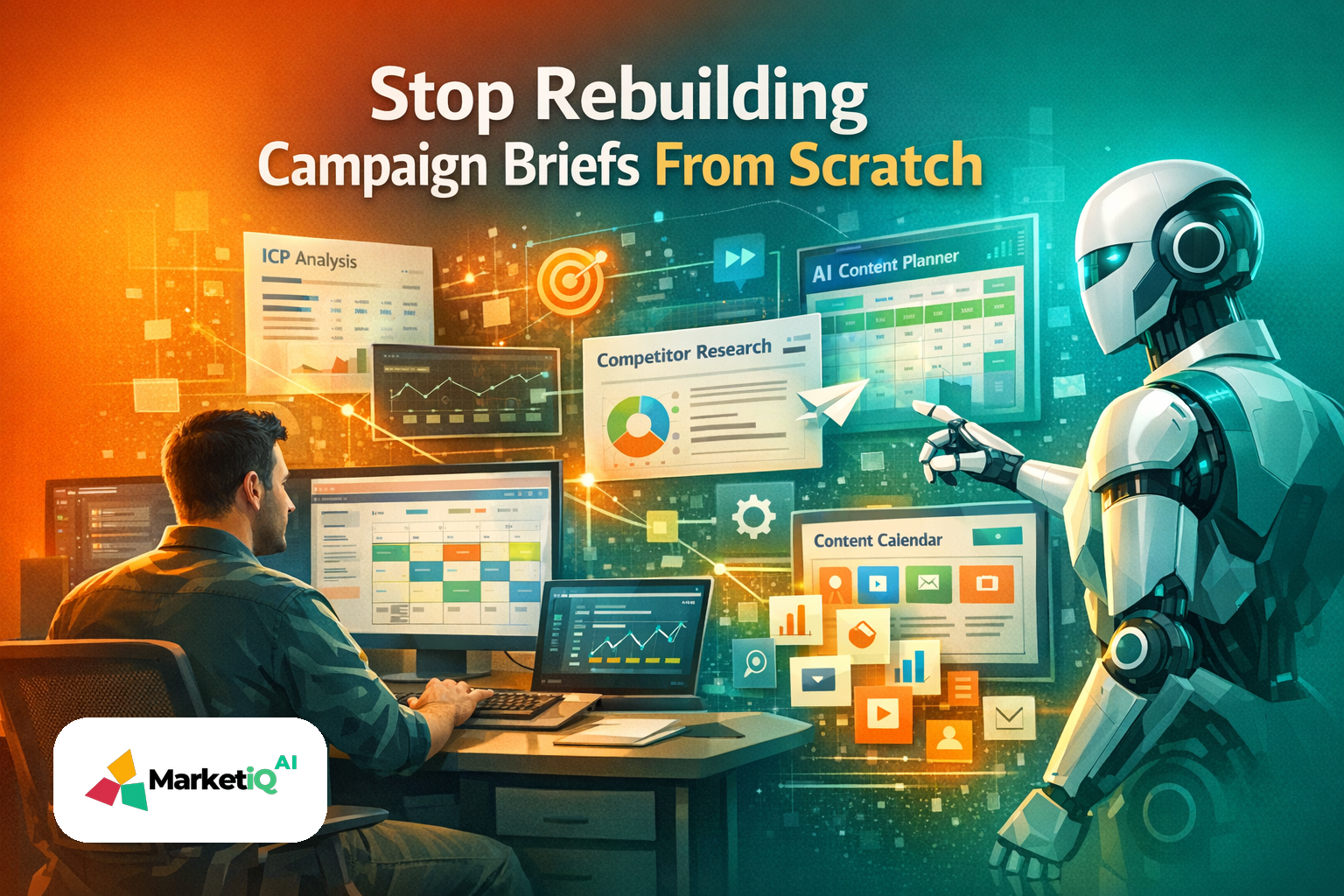
Stop Rebuilding Campaign Briefs From Scratch: Turn ICP Signals Into an Autonomous GTM Calendar
Your campaign brief is leaking GTM memory.
Every time your team opens a blank doc to build the next webinar, LinkedIn series, SEO cluster, outbound sequence, or launch campaign, you lose context: customer objections, closed-won patterns, competitor moves, sales-call language, ad performance, search intent, and the last campaign’s lessons.
That is the real cost of manual marketing research. Not just hours lost. Memory lost.
So the better question is not simply, “How do I automate marketing research and turn ICP insights into a content calendar?”
The better question is: How do you build a governed system where research, ICP learning, content planning, publishing, attribution, and optimization compound instead of resetting every campaign?
That is the operating model MarketiQ was built for. MarketiQ is an autonomous go-to-market operating system led by an AI CMO, powered by 46 AI agents and 31 autonomous loops. It researches markets, mines ICP signals, analyzes competitors, creates content, routes approvals, publishes across channels, measures performance, and feeds results back into one revenue graph.
Not a prompt box. Not a content spinner. A governed GTM engine with Brand Brain, source tracking, approval workflows, audit trails, and human-controlled autonomy.
Here is how to turn fragmented research into an ICP-driven content calendar that can actually learn.
Why Automating Marketing Research Matters
Most lean B2B SaaS teams do research in bursts.
A founder checks competitor sites before a launch. A marketer scans LinkedIn comments before writing posts. Sales shares objection notes in Slack. Someone exports CRM data before a board meeting. Then the next campaign starts, and the intelligence disappears into docs, spreadsheets, call notes, and personal memory.
That creates four problems:
- Your content reflects assumptions, not evidence. Messaging gets built from internal opinions instead of real ICP questions, objections, triggers, and buying language.
- Your team repeats work. Each campaign requires fresh manual research because there is no shared memory layer.
- Your channels disconnect. SEO, ads, email, outbound, and social each run on separate briefs with different insights.
- Your attribution loop breaks. You cannot reliably connect the research that shaped a campaign to the pipeline it influenced.
Automation matters because GTM research is not a one-time task. It is a loop.
A serious research system should continuously capture:
- ICP pain points from sales calls, demos, support tickets, reviews, and CRM notes
- Audience questions from search, community discussions, social comments, and competitor content
- Competitor positioning, pricing-page changes, feature launches, and category narratives
- Performance signals from ads, landing pages, email, content, and pipeline reports
- Source URLs, timestamps, confidence scores, and approval status for every claim
In MarketiQ, these signals do not sit in a spreadsheet. They feed the revenue graph, where the AI CMO can connect customer segments, content themes, campaign performance, channel data, and pipeline outcomes.
That is how your content calendar becomes a strategic GTM asset instead of a publishing checklist.
Define Your ICP Before You Automate Anything
Automation will only scale the quality of your inputs. If your ICP is vague, the system will generate vague content faster.
Before building an automated research workflow, define your ICP in operational terms:
- Firmographics: company size, ARR range, funding stage, geography, industry, tech stack
- Buying committee: founder, VP Marketing, Head of Growth, RevOps, CFO, agency owner
- Trigger events: new funding, missed pipeline target, product launch, market expansion, hiring freeze, agency churn
- Pain intensity: what problem is urgent enough to create budget now?
- Current alternatives: internal execution, freelancers, agencies, point tools, legacy automation platforms
- Objections: trust, implementation time, data access, governance, brand safety, AI quality
- Success metrics: pipeline created, CAC efficiency, qualified demo volume, content-assisted opportunities, tool consolidation, speed to launch
For MarketiQ’s own ICP, for example, the strongest fit is not “any company that wants AI marketing.” It is a funded Seed to Series B B2B SaaS company with 10-100 employees, $1M-$20M ARR, a lean 1-5 person marketing team, and 8-10+ disconnected GTM tools.
That specificity changes the content calendar.
Instead of generic topics like “Benefits of AI in Marketing,” the system can generate sharper assets:
- “How a Seed SaaS Founder Can Launch a Full-Funnel Campaign Without Hiring Marketing Ops”
- “The Hidden Cost of Running 10 GTM Tools With No Shared Revenue Graph”
- “What to Automate First When Your Marketing Team Is One Person”
- “How to Govern AI-Generated Campaigns Before They Touch Paid Spend”
The ICP definition becomes the filter for every research source, content idea, and campaign recommendation.
Tools to Automate Marketing Research Without Creating Another Silo
Many teams try to automate research by adding another workflow tool, scraper, AI writer, SEO platform, social scheduler, or dashboard.
That helps with isolated tasks. It does not solve the GTM memory problem.
General workflow automation platforms can move tasks between systems. Microsoft Power Automate, for example, describes its role as automating workflows and business processes across apps, systems, and websites using AI, digital, and robotic process automation (https://www.microsoft.com/en-us/power-platform/products/power-automate/).
Useful category. Wrong center of gravity for autonomous GTM.
A lean SaaS team does not just need tasks moved from one app to another. It needs a system that understands:
- Who you sell to
- What they care about
- What competitors are saying
- Which messages convert
- Which content assists pipeline
- Which channels deserve more budget
- Which claims require approval
- Which lessons should inform the next campaign
That is why MarketiQ works as a GTM operating system, not a generic automation layer.
The core components are:
- AI CMO: coordinates strategy, prioritization, campaign planning, and optimization
- 46 AI agents: handle research, ICP analysis, content, ads, SEO, outreach, reporting, and performance learning
- 31 autonomous loops: monitor, recommend, test, optimize, and feed outcomes back into the system
- Brand Brain: keeps tone, messaging, design rules, product language, and claim standards consistent
- Revenue graph: connects audience, content, campaign, channel, CRM, and attribution data
- Governance layer: approval gates, role-based permissions, audit trails, source records, and kill-switches
The goal is not to “automate content.”
The goal is to automate the evidence chain from market signal to content decision to pipeline learning.
How to Gather ICP Insights Automatically
A scalable research workflow starts with signal ingestion.
For a B2B SaaS team, useful inputs often include:
- Website pages: homepage, pricing, product pages, docs, comparison pages
- CRM records: opportunities, lifecycle stages, lost reasons, deal notes
- Sales calls: transcripts, objections, competitor mentions, feature requests
- Support tickets: friction points, repeated confusion, expansion opportunities
- Ad accounts: creative tests, CTR, CPC, conversion rate, audience segments
- Search data: queries, impressions, ranking pages, question clusters
- Social data: comments, founder posts, competitor engagement, category debates
- Competitor sites: positioning, pricing language, integrations, launch pages
The workflow should not simply summarize this data. It should structure it.
A strong ICP insight record includes:
- Signal: “Founder says they cannot justify another agency retainer without pipeline attribution.”
- Source: CRM lost reason, sales-call transcript, LinkedIn comment, competitor comparison page, or customer interview
- Timestamp: when the signal was captured
- Segment: Seed B2B SaaS founder, VP Marketing, agency owner, growth lead
- Funnel stage: awareness, consideration, evaluation, expansion
- Pain category: attribution, speed, cost, governance, content scale, stack sprawl
- Confidence level: single anecdote, repeated signal, CRM-backed pattern, performance-backed insight
- Recommended action: blog, landing page, ad test, sales enablement asset, nurture sequence, outbound angle
Example source card:
Insight: “Lean teams do not want another AI writer; they want a system that ships campaigns and proves impact.”
Source: three demo-call transcripts + pricing-page session recordings + CRM notes from evaluation-stage opportunities
Timestamp: 2026-07-09
Confidence: medium until validated against campaign performance
Content action: create comparison page and consideration-stage blog on AI CMO vs AI copywriting tools
This is where governance matters. If a source is weak, the system should label it as weak. If a claim requires legal, brand, or executive review, it should route for approval before it becomes public content.
Autonomy without source discipline creates risk. Governed autonomy creates leverage.
Turn ICP Insights Into Topics and an Automated Content Calendar
Once insights are structured, the next step is topic generation.
Do not start with keywords alone. Start with ICP tension.
A useful content topic should connect:
- A specific buyer
- A painful trigger
- A current workaround
- A sharper point of view
- A measurable next step
For example:
ICP signal: VP Marketing has 10 tools but no unified attribution.
Content angle: “Your Martech Stack Is Producing Activity, Not GTM Memory.”
Asset type: consideration-stage blog + LinkedIn founder post + comparison landing page.
CTA: workflow audit.
ICP signal: founder is still writing campaign briefs manually.
Content angle: “Stop Rebuilding Campaign Briefs From Scratch.”
Asset type: SEO article + demo walkthrough + nurture email.
CTA: see the AI CMO build a campaign calendar from CRM and website data.
ICP signal: growth lead worries AI will publish off-brand content.
Content angle: “How to Let AI Run GTM Without Letting It Run Wild.”
Asset type: governance guide + product page section + sales deck slide.
CTA: review MarketiQ’s approval and audit workflow.
From there, the automated calendar should prioritize by business value, not just publishing frequency.
A MarketiQ-style content calendar includes:
- Theme: stack replacement ROI, governed autonomy, evidence-first strategy, closed-loop learning
- ICP segment: founder, VP Marketing, growth lead, agency owner
- Funnel stage: awareness, consideration, decision, retention
- Primary channel: blog, LinkedIn, email, paid social, search, outbound
- Source evidence: research cards attached to each asset
- Owner: AI-generated, human-reviewed, executive-approved, or sales-enabled
- Risk tier: low-risk educational, medium-risk comparison, high-risk claim or regulated language
- Publishing date: mapped to launches, sales pushes, market moments, and campaign sequences
- Success metric: demo requests, assisted pipeline, qualified traffic, reply rate, conversion rate, CAC efficiency
That structure turns the calendar into a command center. Every asset has a reason to exist.
Measure, Learn, and Govern the Loop
The final step is where most content systems fail.
They publish. They report traffic. Then they move on.
An autonomous GTM calendar should keep learning after publish.
Measure performance at four levels:
- Content performance: impressions, clicks, scroll depth, engagement, search visibility
- Conversion performance: demo requests, form fills, qualified replies, email signups, content downloads
- Pipeline performance: influenced opportunities, stage movement, deal velocity, closed-won association
- Learning performance: which ICP pains, claims, formats, channels, and CTAs should be reused or retired
The learning layer matters more than the dashboard.
If a blog about “governed AI marketing” drives qualified demo requests from VP Marketing accounts, that should influence paid creative, outbound messaging, sales talk tracks, nurture emails, and the next content cluster.
If a LinkedIn post about “AI writing tools vs AI CMO” produces high engagement but no qualified conversions, the system should not blindly repeat the format. It should test a sharper CTA, different funnel stage, stronger proof, or a decision-stage landing page.
This is the role of MarketiQ’s autonomous loops: monitor outcomes, identify patterns, recommend changes, route approvals, update campaign memory, and improve the next GTM cycle.
Governance stays active throughout:
- Claims remain tied to sources
- Brand Brain checks voice and messaging consistency
- Approval gates control publishing and spend changes
- Audit trails record what changed, who approved it, and why
- Kill-switches allow humans to pause campaigns or agents when needed
That is the difference between scalable automation and uncontrolled output.
Best Practices for Scalable Research Automation
If you are building this workflow now, start with these rules:
1. Centralize evidence before automating output.
Do not generate a 90-day calendar from disconnected notes. First unify CRM, website, sales, content, and campaign signals.
2. Treat every insight as a sourced object.
Every recommendation should have a source, timestamp, confidence level, and owner.
3. Separate weak signals from proven patterns.
One customer comment can inspire a test. It should not become a core positioning claim without validation.
4. Build by funnel stage.
Awareness content should create category understanding. Consideration content should reframe alternatives. Decision content should reduce risk and prove fit.
5. Give AI clear autonomy boundaries.
Low-risk drafts can move quickly. High-risk claims, paid budget changes, comparison pages, and executive POV should require approval.
6. Close the loop into pipeline.
Traffic alone is not enough. Connect content topics to qualified conversions, opportunities, and revenue influence wherever possible.
7. Make the calendar adaptive.
A static calendar becomes stale the moment new market signals arrive. Your system should revise priorities as ICP behavior changes.
The companies that win with AI GTM will not be the ones generating the most content. They will be the ones building the strongest memory loop between market evidence and revenue execution.
Your next campaign brief should not start from scratch.
It should start from everything your market has already told you.
See how MarketiQ turns your CRM, website, campaign data, and ICP research into a governed autonomous content calendar. Book a MarketiQ workflow audit.
- #Automate
- #Marketing
- #Research
- #ICP
- #GTM
- #AIMarketing
- #ContentStrategy
This article describes practices and observations; it is not a promise of rankings, deliverability or revenue. Verify cited sources and their dates before making decisions.
Related reading
- 1MarketiQ vs Clay comparisonLinked from this article
- 2MarketiQ vs Jasper AI ComparisonLinked from this article
- 3Governed Autonomy Buyer ChecklistLinked from this article