Governed Pipeline Attribution
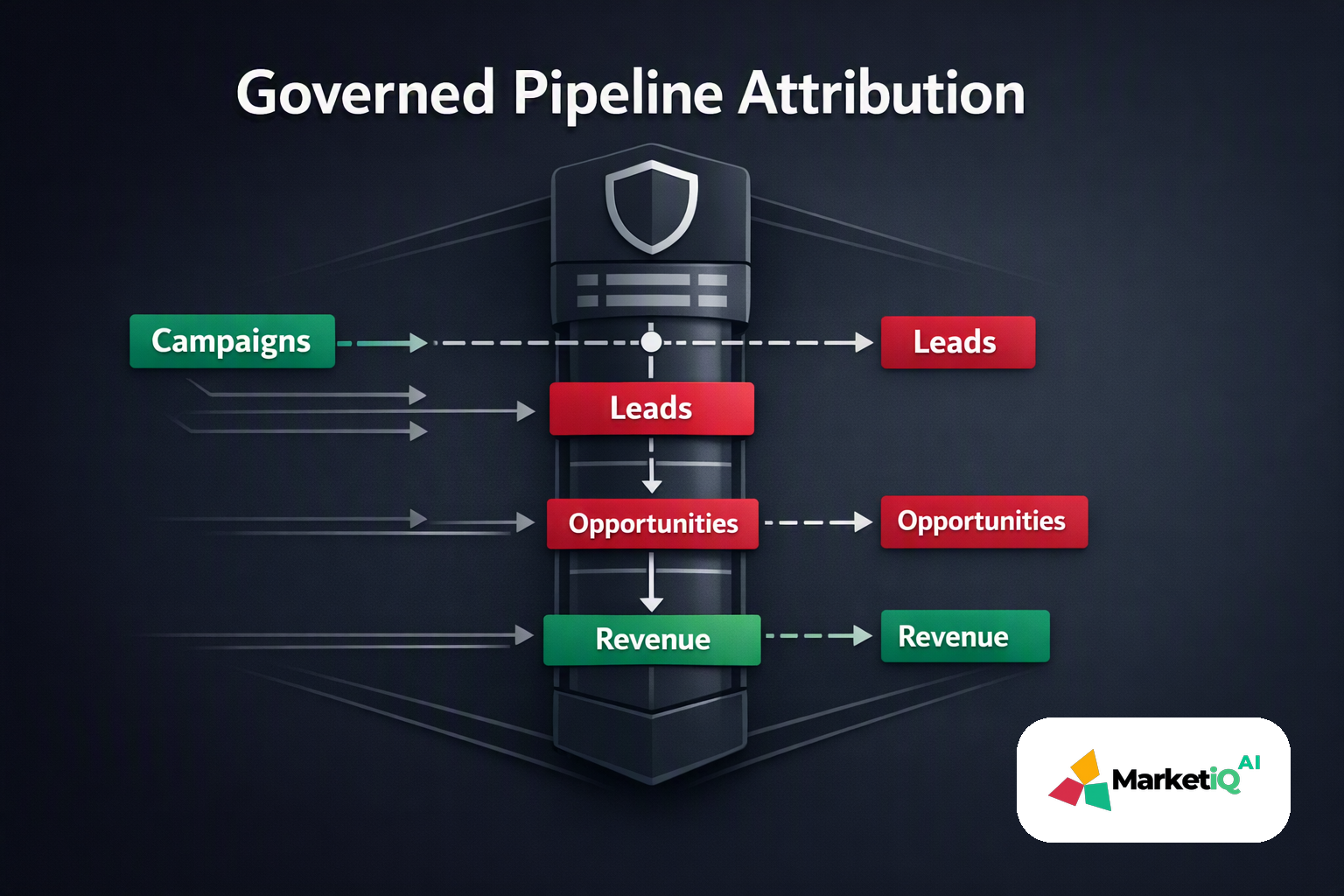
Before you credit a campaign with pipeline, answer five questions about what happened, what it relates to, and how strong the evidence is.
A campaign tool can report clicks. A CRM can report pipeline. An advertising provider can report that an asset was submitted or accepted. None of those records, by itself, proves the path between marketing activity and pipeline revenue.
Marketing attribution for pipeline revenue is the method of relating identifiable marketing influence to opportunities, pipeline value and, where available, closed revenue, while showing the evidence and limits behind each relationship.
For a funded B2B SaaS company with one to five marketers and an eight-to-15-tool stack, that distinction matters. Reporting tells the team what happened in separate systems. Attribution helps decide what deserves another dollar, which workflow needs repair and where the evidence is too weak to support a confident decision.
MarketiQ AI is built around that difference. Its coordinated GTM loop connects research, strategy, creation, approval-gated activation, delivery reconciliation, CRM outcomes and the next recommendation. The goal is not to manufacture causal certainty. It is to make the evidence chain visible enough for a marketing leader to act responsibly.
Attribution Versus Activity Reporting
Activity reporting answers questions such as:
- How many impressions did the campaign receive?
- How many people clicked the email?
- Which LinkedIn post was published?
- How many form fills entered the CRM?
Those answers are useful, but they remain local to a channel or system. A report may show that an ad received engagement and that an opportunity was later created. It does not automatically establish that the ad influenced the opportunity, how much influence it had or whether the provider actually delivered the intended action.
Attribution adds relationships and decision rules. It connects a marketing touchpoint to an account, contact, opportunity or campaign record, then applies a stated method for assigning influence. A pipeline attribution record should make clear:
- What happened: the asset, channel, account, date and delivery state.
- What it relates to: the qualified lead, account, opportunity or revenue record.
- How the relationship was assigned: first-touch, last-touch, multi-touch, account-level or another model.
- How strong the evidence is: observed, inferred, incomplete or disputed.
- What decision follows: continue, change, pause or gather more evidence.
MarketiQ AI's approval gates and traceable provider outcomes support the first part of this chain. A workflow can distinguish approved work from submitted work, and submitted work from an accepted, uncertain or failed provider outcome. That matters because an attribution record built on an assumed publication is weaker than one tied to a recorded delivery result.
What Pipeline Revenue Attribution Must Define
Before choosing a model, define the objects being measured. Otherwise, the team can assign precise-looking credit to ambiguous events.
Marketing-sourced pipeline generally refers to opportunities where marketing initiated the qualifying journey under the company's chosen rules. Marketing-influenced pipeline is broader: marketing contributed at least one meaningful touchpoint during the buyer journey, whether or not it created the first contact.
Neither definition is automatically correct for every business. A founder-led SaaS company with long sales cycles may need account-level influence rules because several people engage before an opportunity exists. A product-led motion may need to connect content, product activity and expansion opportunities. The operating rule should be documented before the number is used in a budget meeting.
Revenue also needs a clear status. Separate:
- Pipeline created: the opportunity entered the CRM with a defined value.
- Pipeline progressed: the opportunity moved through a stated stage or qualification threshold.
- Closed-won revenue: the opportunity became revenue under the CRM or finance definition.
- Forecast or expected revenue: a projection, not an observed outcome.
MarketiQ AI can coordinate these records across its GTM workflow, but the system should not imply that an observed touchpoint caused a closed deal. Attribution is evidence allocation. Causal proof requires stronger study design, such as controlled experiments or carefully constructed comparisons.
The Evidence-to-Decision Workflow
For a lean B2B SaaS team, useful attribution has five connected stages.
1. Establish the research and campaign context
The team records the audience, problem, offer, target accounts, intended channel and decision the campaign is meant to inform. MarketiQ AI's research and strategy stages provide the shared context; Brand Brain carries the company's audience, offer, voice and prior performance into downstream work.
This prevents an isolated content or campaign output from becoming an attribution event without a defined purpose.
2. Create and approve the activation
The system produces the planned asset or action, then pauses at the relevant approval gate. The reviewer can assess the content, evidence, permission, provider and intended audience before activation.
For attribution, approval is not the same as delivery. It is the boundary between authorized intent and an action that may enter the market.
3. Reconcile the provider outcome
After submission, record what the connected provider reports. A post can be accepted, rejected, delayed or returned with an uncertain status. A campaign can be marked active while a downstream event remains incomplete.
This is where delivery receipts and traceable provider outcomes become important. They give the team a more defensible starting point than assuming every approved action reached its destination.
4. Relate activity to CRM outcomes
Match the delivered activity to known accounts, contacts, campaigns and opportunities using consistent identifiers, timestamps and source rules. Record the relationship as observed or inferred. Keep unmatched activity visible instead of silently dropping it.
MarketiQ AI's 45 AI agents, 26 optimization loops and 30+ connected GTM modules are relevant here only if they preserve that context across research, activation, measurement and reconciliation. The value is the connected workflow, not the agent count alone.
5. Feed the finding into the next recommendation
The final output should be a decision, not another dashboard. Continue the campaign because target accounts progressed. Revise the message because engagement occurred without qualified pipeline. Fix the provider connection because delivery is uncertain. Stop spending because the evidence does not support the intended outcome.
The recommendation should include its source records, confidence and missing evidence. That is the difference between an evidence-led loop and automated reporting.
Choosing an Attribution Model for the Decision at Hand
There is no universal model that converts fragmented GTM activity into objective truth. Choose the model based on the question being answered.
First-touch attribution fits a narrow question: which recorded source introduced the account or contact? It can help assess discovery channels, but it undervalues later education and conversion work.
Last-touch attribution asks which recorded interaction preceded conversion or opportunity creation. It is useful for reviewing the immediate conversion path, but it can over-credit a form fill or meeting request while ignoring earlier influence.
Multi-touch attribution distributes credit across multiple recorded interactions. Use it when several meaningful touches are visible and the team needs a broader view of the journey. Treat the allocation as a chosen rule, not a causal measurement. Missing contacts, offline conversations and anonymous research can distort the result.
Account-level attribution is often a practical fit for B2B SaaS. It relates marketing activity from multiple people at one account to an opportunity. This can reflect buying-group behavior better than forcing every touchpoint to one contact, but it requires reliable account matching and clear inclusion rules.
Position-based or weighted models assign more credit to selected stages, such as first engagement, qualified conversion and opportunity creation. They are useful when the business has a specific operating theory to test. Publish the weighting. Do not present it as discovered fact.
For MarketiQ AI, the model should be attached to the campaign decision and displayed alongside evidence quality. A recommendation might say: account-level influence is observed for delivered assets and CRM stage progression, but anonymous research and offline sales touches are not reconciled. That is actionable without overstating certainty.
Common Data Gaps and Attribution Mistakes
The most damaging errors usually occur before the model is selected.
- Treating an approved asset as published without checking the provider outcome.
- Counting clicks as pipeline without a CRM relationship or defined qualification event.
- Mixing sourced, influenced, forecast and closed-won revenue in one number.
- Changing attribution rules between campaigns, making comparisons unreliable.
- Giving credit to a channel because it was present, even when the activity was not delivered.
- Ignoring untracked sales, partner, event or peer interactions while claiming a complete buyer journey.
- Reporting a model's allocated credit as proof that marketing caused the opportunity.
A useful implementation starts with a small workflow: one campaign, one audience, one activation path and one CRM outcome. Document the identifiers, approval status, delivery states, attribution rule, confidence labels and decision thresholds. Then compare the before-and-after workflow time and inspect the unmatched records.
MarketiQ AI can provide the operating layer for that test, with governed permissions, shared brand context, approval gates, connected provider records and learning loops. Product capability should still be validated against the team's actual CRM, providers and integration requirements.
The Takeaway: Attribute Evidence, Then Decide
Marketing attribution for pipeline revenue is not a prettier activity report. It is a governed method for relating delivered marketing work to pipeline evidence, stating how credit was assigned and showing what remains unknown.
For a lean SaaS team, the immediate goal is not a perfect revenue model. It is a traceable path from research insight to approved activation, provider outcome, CRM relationship and next campaign decision.
Download the pipeline attribution workflow checklist or request a MarketiQ AI workflow review to map that path across your current stack.
This article describes practices and observations; it is not a promise of rankings, deliverability or revenue. Verify cited sources and their dates before making decisions.
Related reading
- 1Close the Campaign-to-Revenue Handoff Without Losing the EvidenceLinked from this article
- 2MarketiQ AI vs HubSpotLinked from this article
- 3From GTM Tool Stack to GTM Execution System: A Launch-Week PlaybookLinked from this article