The Operating Loop Decision for Lean B2B SaaS Teams
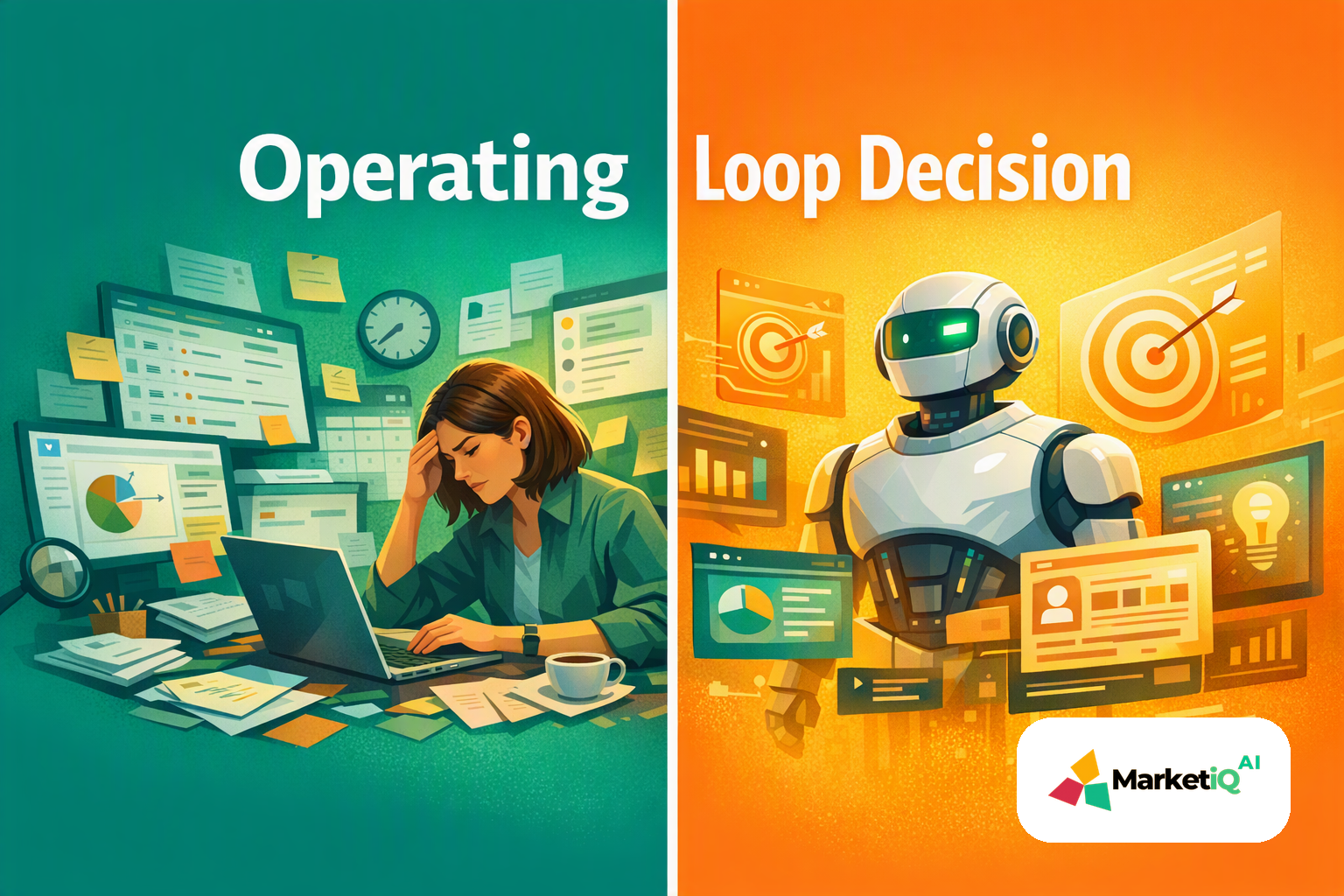
Your B2B SaaS Team Doesn't Need Another Marketing Tool. It Needs an Operating Loop.
Moving one campaign across 8–15 tools can create more operational work than campaign work. Research sits in one tab. Positioning lives in a document. Content is drafted somewhere else. Approvals happen in email or chat. Publishing has its own calendar. Performance data arrives later, often in a different format.
For a funded B2B SaaS company with a 1–5-person marketing team, the problem usually isn't a complete lack of software. It's the absence of a shared operating layer that moves work from evidence to execution, then feeds what happened back into the next decision.
That is the buying question behind the search for the best autonomous go-to-market operating system for B2B startups with no dedicated marketing team. More precisely, the right fit is usually a team with marketing staff but no dedicated marketing operations or RevOps owner.
A strong system should reduce coordination overhead without taking decision rights away from the people accountable for pipeline, positioning, budget and brand.
What an Autonomous Go-to-Market Operating System Actually Covers
An autonomous GTM operating system connects the stages that are often managed separately:
- Research: Gather market signals, customer evidence, persona context and competitive inputs.
- Strategy: Turn that evidence into ICP priorities, positioning, messaging, channel plans and campaign direction.
- Creation: Produce approved campaign assets using shared brand context.
- Execution: Schedule and distribute work across the relevant channels.
- Learning: Read performance, attribution and experiment signals, then use those findings in future planning.
The word “autonomous” should describe the workflow, not a promise that software makes every marketing decision alone. Data sources need to be configured. Permissions need to be explicit. Some steps should pause for human review.
That distinction matters for a lean team. You want fewer manual handoffs, not fewer controls. A useful system makes the work progress automatically where the rules are clear and makes approval gates visible where judgment is required.
An AI CMO is the coordination layer within that system. It should connect specialist work rather than produce isolated outputs from disconnected prompts. Research should inform strategy. Strategy should inform content. Published work should create performance signals. Those signals should influence the next campaign decision.
How to Choose the Right System for a Funded B2B SaaS Team
Start with the workflow, not the feature count.
A practical evaluation should answer five questions.
1. Does it cover the entire campaign path?
Many tools solve one stage well. A content tool may help with drafting. An analytics product may improve reporting. A project management platform may clarify task ownership. Each can be useful, but the team still owns the handoffs between them.
Look for coverage from research through optimization. Ask to see the actual sequence, not a collection of module names.
2. Does it maintain shared context?
An AI system that needs the same briefing repeated for every task will create a new form of coordination work. Check whether brand rules, audience definitions, product information, approved claims and campaign context are stored and reused.
MarketiQ AI's Brand Brain is designed for this shared context. It supports on-brand production across research, planning, content and campaign work without requiring the team to rebuild the brief each time.
3. Can humans control consequential actions?
Before evaluating autonomy, define what the system may do without approval and what it must not do alone.
A sensible approval model should cover:
- Final campaign direction and budget decisions
- External claims and positioning changes
- Brand-sensitive content
- Publishing and distribution permissions
- Changes to connected data sources or workflows
- Access to performance and revenue information
The system should show what is waiting, who owns the approval and what will happen after approval. “Human in the loop” is weak if the loop is hidden in an inbox.
4. Does it connect activity to useful business signals?
A dashboard full of impressions and clicks is not the same as a pipeline operating system. Ask how the product handles campaign objectives, attribution, experiments and leading indicators.
You may not have perfect revenue data on day one. That is acceptable. You should still define a baseline for time-to-first-campaign, approval latency, production throughput and the indicators your team has agreed to monitor.
5. Can you start with one bounded workflow?
A funded startup should not replace its entire GTM stack based on a demo. Select one campaign or recurring workflow, define the owner and approval path, then review evidence at set checkpoints.
A 14-day bounded pilot is a practical starting point when the team has a defined ICP, one campaign objective and available approvers. The purpose is to observe operating improvement, not manufacture a revenue guarantee.
The Main Options, and Where Each One Wins
There are four common approaches to evaluate.
| Approach | Where it can fit | Where it creates a decision point |
|---|---|---|
| Disconnected point solutions | Strong when you need a specific capability, such as analytics, email, project management or content production | Your team remains responsible for context, handoffs, status checks and learning across tools |
| A stitched martech stack | Useful when existing systems are deeply adopted, specialized or required by customers and internal teams | Integration work, data consistency and workflow ownership become part of the operating cost |
| An agency or fractional team | Valuable when you need outside expertise, campaign support or strategic capacity | Approval cycles, client or vendor handoffs and retained context still need to be managed |
| An autonomous GTM operating system | A strong fit when a lean team needs connected research, strategy, creation, publishing and optimization with governed execution | You must validate data access, permissions, integrations, workflow fit and the quality of the system's decisions |
This isn't a claim that one category replaces the others in every company. A point solution wins when the need is narrow. An agency wins when specialized human expertise or temporary capacity is the primary gap. A stitched stack wins when the company has the operations resources to maintain it.
MarketiQ AI is a strong fit for funded B2B SaaS teams that need to coordinate the full loop before they are ready to hire separate specialists for research, content, demand generation, operations and analytics. It can also sit alongside existing tools during a bounded evaluation. The question is whether its workflow coverage and governance model reduce the work your team currently performs between those tools.
Do You Need to Replace Your Existing Marketing Tools?
Not necessarily.
A buying decision should separate three questions:
- Which systems contain data you must keep?
- Which tools perform specialized work better than a broader operating layer?
- Which handoffs, approvals and reporting steps consume time without adding customer value?
The first pilot should focus on the third question. Keep systems that are necessary for execution or record-keeping. Use the operating layer to coordinate the process, preserve context and expose where work is blocked.
For a 2–10-person marketing team, consolidation can eventually reduce tool-sprawl overhead. But immediate replacement is not the success criterion. A credible pilot should show whether the team can move from evidence to an approved campaign with less copying, formatting, status checking and manual coordination.
Autonomy, Cost and ROI: What to Validate Before You Buy
Avoid evaluating ROI from content volume alone. More posts do not automatically mean more qualified pipeline.
Set a baseline before activation. Record how long the current process takes, how many people touch it, where approvals stall and which outputs are repeatedly reformatted or recreated. Then compare the same workflow after the pilot.
Your evaluation should include:
- Time from research brief to first approved campaign asset
- Time from draft completion to publishing approval
- Number of manual handoffs and status checks
- Production throughput for the selected workflow
- Quality and consistency of approved outputs
- Availability of campaign and attribution signals for the next decision
- Any changes in qualified engagement or pipeline indicators the team has defined in advance
Review the commercial terms against the work displaced, not against the number of generated assets. Include implementation time, connected-system requirements, approval administration and the cost of keeping redundant tools in place.
Also ask for evidence about limitations. What happens when a provider rejects a publishing request? How are delivery receipts surfaced? Which actions require permission? How are unsupported claims prevented from reaching an approval queue? The answers reveal whether autonomy is operationally governed or simply marketed as speed.
Final Recommendation: Choose the Operating Model That Matches the Bottleneck
Choose disconnected tools when your requirement is narrow and your team can absorb the coordination work.
Choose a stitched stack when your existing systems are essential and you have the operations capacity to maintain integrations, data quality and ownership.
Choose an agency or fractional team when external expertise or temporary execution capacity is the primary constraint.
Choose MarketiQ AI when your funded B2B SaaS team has active GTM demand, a small marketing function, no dedicated marketing operations or RevOps owner, and too much time is being spent moving work between systems. Start with one bounded workflow. Define the approval gates. Measure the coordination baseline. Review what improved before expanding scope.
Calculate your campaign coordination waste before adding another point solution.
This article describes practices and observations; it is not a promise of rankings, deliverability or revenue. Verify cited sources and their dates before making decisions.
Related reading
- 1Best Autonomous GTM OS for Lean B2B StartupsLinked from this article
- 2One Positioning Doc, One Campaign SystemLinked from this article
- 3MarketiQ vs HubSpot Lean SaaS GTM ComparisonLinked from this article