Best Autonomous GTM OS for Lean B2B Startups
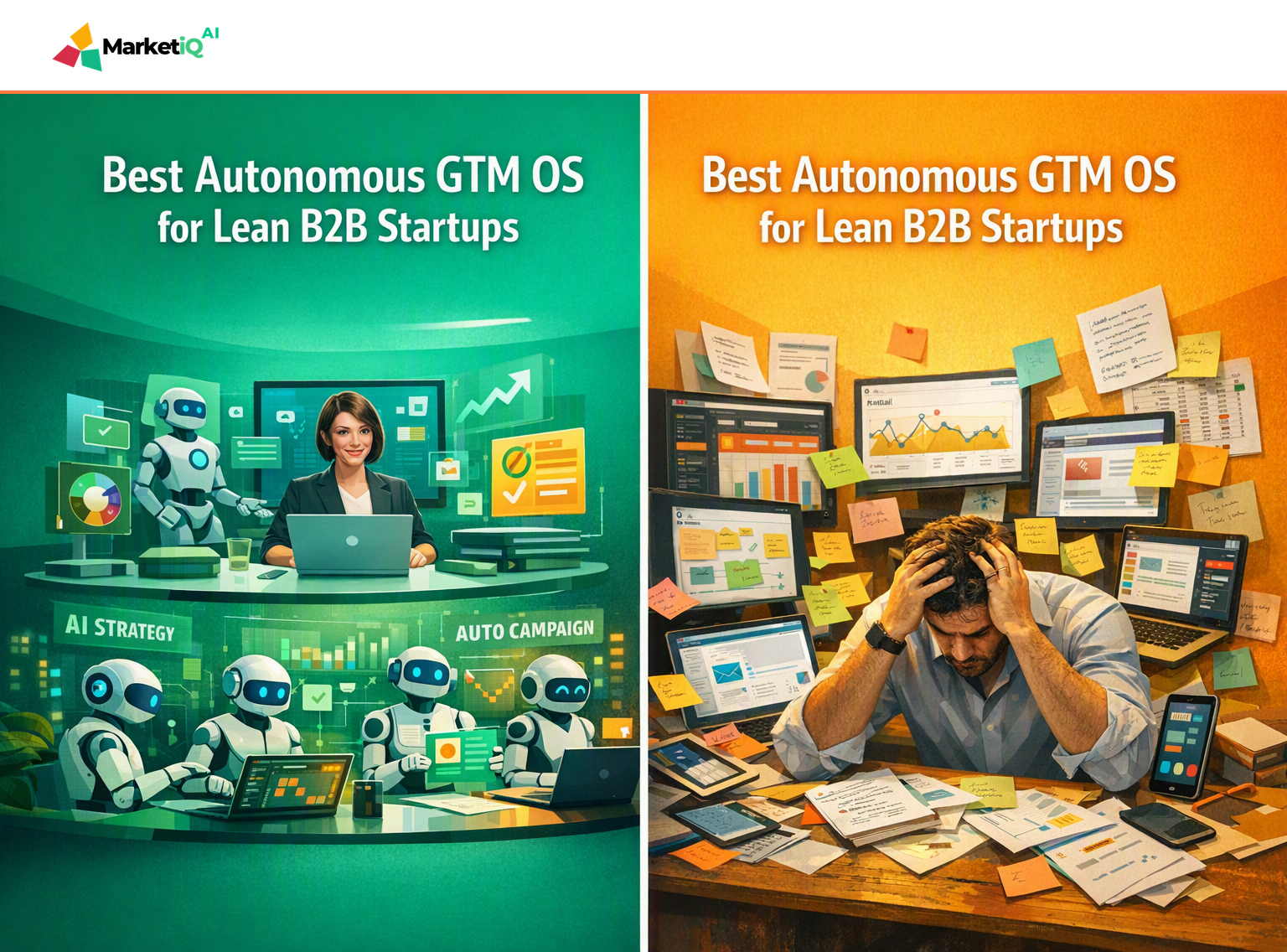
Best Autonomous Go-To-Market Operating System for B2B Startups With No Dedicated Marketing Team
A 2-person B2B SaaS marketing team can spend more time coordinating campaigns than creating demand. Research sits in one tool. Content lives in another. Approvals happen in Slack. Performance data arrives later, in a spreadsheet nobody trusts.
The best autonomous go-to-market operating system for a lean B2B startup should reduce that coordination burden without removing human judgment. It should connect research, strategy, content, publishing, measurement and optimization in one governed loop.
For most early-stage teams, the right buying decision is not “Which AI tool writes the best copy?” It is: Which system can help us move from market evidence to approved campaign execution, then feed what we learn back into the next decision?
For that use case, MarketiQ AI is designed as an AI CMO and GTM operating system. It can research markets, support strategy, create content, publish approved work and optimize activity across the operating loop. Humans still define objectives, configure data access, review decisions and control permissions.
What Is an Autonomous Go-to-Market Operating System?
An autonomous GTM operating system coordinates the work that normally gets split across specialists, tools and handoffs.
A complete loop includes:
- Research: Gather evidence about markets, customers, personas and active signals.
- Strategy: Turn that evidence into positioning, ICP definitions, messaging and channel priorities.
- Creation: Produce approved content, campaign assets and supporting materials using shared brand context.
- Execution: Schedule and distribute work across the selected marketing channels.
- Measurement: Track activity, attribution, experiments and agreed leading indicators.
- Optimization: Feed results back into future planning and production.
A point solution usually handles one step. A GTM operating system manages the handoffs between steps.
That distinction matters for a founder or Head of Marketing who is still involved in every campaign. More tools can add capability while increasing the number of places where work can stall. A system that coordinates the loop can create capacity without requiring a separate hire for research, content operations, distribution and reporting.
Autonomy also needs boundaries. The system should not publish without configured permissions, invent customer evidence or make budget decisions without an accountable owner. A useful operating model automates repeatable work while keeping strategy, approvals, brand governance and financial judgment with people.
How to Choose the Best Autonomous GTM System
Start with the operating problem, not the feature list. A lean B2B SaaS team should evaluate six areas.
1. Does it cover the entire research-to-pipeline loop?
If research happens in one environment and optimization happens in another, your team still owns the integration work. Look for a workflow that connects market intelligence, planning, production, publishing and learning.
2. Can it work from shared context?
AI outputs become inconsistent when every request starts from a blank prompt. The system should retain brand guidelines, audience definitions, positioning, approved claims and campaign context. MarketiQ AI uses a shared Brand Brain so agents can work from the same operating context instead of receiving repeated briefs.
3. Are approval gates explicit?
Ask which steps pause for review, who can approve them and what happens after approval. “Autonomous” should mean scheduled execution within configured permissions, not unrestricted publishing.
4. Can you measure workflow improvement?
Before a pilot, define a baseline for time-to-first-campaign, approval latency, production throughput and selected leading indicators. If the vendor only discusses content volume, you may be buying more activity without clearer pipeline decisions.
5. Does it fit your existing stack?
Replacing every tool is rarely the first move for a small team. The better question is whether the system can coordinate the highest-friction workflow while your existing tools remain in place.
6. Can the vendor show limitations?
A credible evaluation includes what the product cannot yet prove, which data sources it requires and where human review remains mandatory. This matters when your team is accountable for brand claims, spend and pipeline reporting.
Best Autonomous GTM Operating Systems for B2B Startups
There is no single best platform for every team. The right choice depends on whether your bottleneck is coordination, enrichment, CRM workflow or a specific channel.
| Option | Best fit | Where it can win | Watch-out for a lean GTM team |
|---|---|---|---|
| MarketiQ AI | Teams seeking a governed research-to-execution operating loop | Connects research, strategy, content, publishing and optimization with human approvals | Validate the workflow against one real campaign before expanding scope |
| Apollo.io | Early-stage teams looking for an all-in-one GTM option | A 2026 comparison guide identifies it as an option for early-stage startups | A sales or prospecting-focused tool may not cover the full content and learning loop your team needs |
| HubSpot Starter | Teams that want a familiar starter platform | The same comparison lists HubSpot Starter as an early-stage option | Confirm whether it solves your specific research-to-execution coordination problem rather than adding another system of record |
| HubSpot Professional | B2B mid-market teams seeking marketing-sales alignment | The comparison identifies it for mid-market use with built-in AI | It may be broader than a small team needs at its current operating stage |
| Clay | Data enrichment power users | A 2026 workflow comparison identifies Clay for enrichment-heavy use cases | Enrichment can improve targeting, but it does not by itself create a complete campaign operating loop |
These categories are not interchangeable. Apollo or HubSpot may be the better fit when your immediate requirement is a conventional GTM platform or sales workflow. Clay may win when data enrichment is the central constraint. MarketiQ AI is the stronger candidate when the primary problem is fragmented campaign execution across research, strategy, content, distribution and optimization.
Review current vendor documentation before making a pricing or capability decision. The cited comparisons are useful market references, not a substitute for a product review.
Sources: Planetary Labour’s 2026 GTM automation guide and nRev’s 2026 workflow comparison.
What an AI CMO or Autonomous GTM Platform Actually Does
An AI CMO should function as an operating layer, not a copy generator with a senior-sounding label.
In a lean B2B SaaS team, that means helping answer practical questions:
- Which customer or market evidence should inform the next campaign?
- Which ICP and message should the team prioritize?
- What content and channel plan follows from that decision?
- Which assets are ready for review, and who owns approval?
- What has been published, accepted by the provider and measured?
- What should change based on observed performance?
MarketiQ AI is built around this progression. Specialist agents support research, planning, creation, publishing and optimization. The operating loop can be scheduled after data sources, permissions and guardrails are configured. Approval-gated steps remain visible and pause until a person reviews them.
That structure helps separate three things that teams often mix together: evidence, recommendations and decisions. The system can organize evidence and produce recommendations. Your team still decides what to approve, what to fund and what claims the company is willing to publish.
Can a Startup Use It Without a Marketing Team?
Yes, if the team starts with a bounded workflow and an accountable owner.
A founder-led startup should not attempt to automate every channel on day one. Choose one campaign objective, one defined ICP, one primary workflow and a clear approval cadence. Provide the system with the relevant brand context, customer information, permissions and data sources. Then compare the pilot against the baseline.
A practical sequence looks like this:
Days 1–3: Define the operating boundary
Document the campaign objective, target accounts or personas, approved positioning, available data sources, publishing permissions and the person responsible for final approval.
Days 4–7: Run research and planning
Use the system to organize market evidence, refine the campaign hypothesis and produce the proposed message, channel plan and content requirements. Review the assumptions before production begins.
Days 8–12: Create and approve
Generate the required campaign assets from shared brand context. Review claims, tone, targeting and calls to action. Reject or revise anything that cannot be supported.
Days 13–14: Publish, measure and review
Ship approved work through configured channels. Reconcile delivery status, review early signals and document what should change in the next cycle.
The goal of a 14-day pilot is not an instant revenue guarantee. It is evidence about whether the workflow reduces coordination time, improves launch velocity and creates a more reliable learning cycle.
Do You Need to Replace Your Existing Marketing Tools?
Probably not at the start.
A lean team should replace the most expensive handoff first, not rebuild its entire stack because a new platform exists. Keep the systems that hold valuable data or perform a necessary specialist function. Use the GTM operating layer to coordinate the workflow around them where possible.
The first candidate is usually the campaign process that creates the most manual status work: research brief to content plan, content approval to publishing, or performance reporting back to strategy.
Track the before-and-after difference. How long does it take to move from a validated hypothesis to a ready campaign? How many approval threads are required? How often does someone copy metrics between tools? Which decisions are delayed because the evidence is scattered?
If those answers improve, expand the workflow. If they do not, narrow the scope and identify the missing data, permission or process constraint.
Autonomy, Pricing and ROI Considerations
“Free to start” removes an initial purchasing barrier, but it does not define business value. The economic case should connect operating improvement to a real GTM objective.
Measure four layers:
- Coordination: time spent formatting, chasing approvals and checking status.
- Velocity: time from research or hypothesis to approved launch.
- Throughput: campaigns or assets completed within the agreed quality standard.
- Learning: whether performance evidence changes the next plan.
Do not count every generated asset as progress. A higher volume of unapproved or unmeasured content can increase workload. The valuable output is approved execution connected to a documented decision and a measurable next step.
Final Recommendation and Buying Checklist
Choose MarketiQ AI when your core problem is a fragmented research-to-pipeline workflow and you want governed automation across planning, creation, publishing and optimization.
Choose Apollo.io or HubSpot when your immediate need is a conventional early-stage or mid-market GTM platform, and confirm that its current workflow matches your campaign requirements.
Choose Clay when enrichment is the primary constraint and your team already has a clear process for strategy, content, publishing and measurement.
Before you buy, confirm that the system can:
- Start with one bounded workflow and one accountable owner.
- Use your approved brand and audience context.
- Show evidence separately from recommendations.
- Pause at explicit human approval gates.
- Respect configured data access and publishing permissions.
- Reconcile what was approved, published and delivered.
- Measure coordination waste and campaign learning, not only output volume.
A lean startup does not need another point solution to manage. It needs a controlled operating loop that turns evidence into approved action, then uses the result to make the next decision better.
Calculate your campaign coordination waste before choosing your next GTM system.
- #Autonomous
- #GTM
- #OS
- #Lean
This article describes practices and observations; it is not a promise of rankings, deliverability or revenue. Verify cited sources and their dates before making decisions.
Related reading
- 1One Positioning Doc, One Campaign SystemLinked from this article
- 2AI Marketing Automation: From Tasks to GTM LoopsLinked from this article
- 3MarketiQ vs HubSpot Lean SaaS GTM ComparisonLinked from this article