HubSpot Alternative for Lean B2B Teams
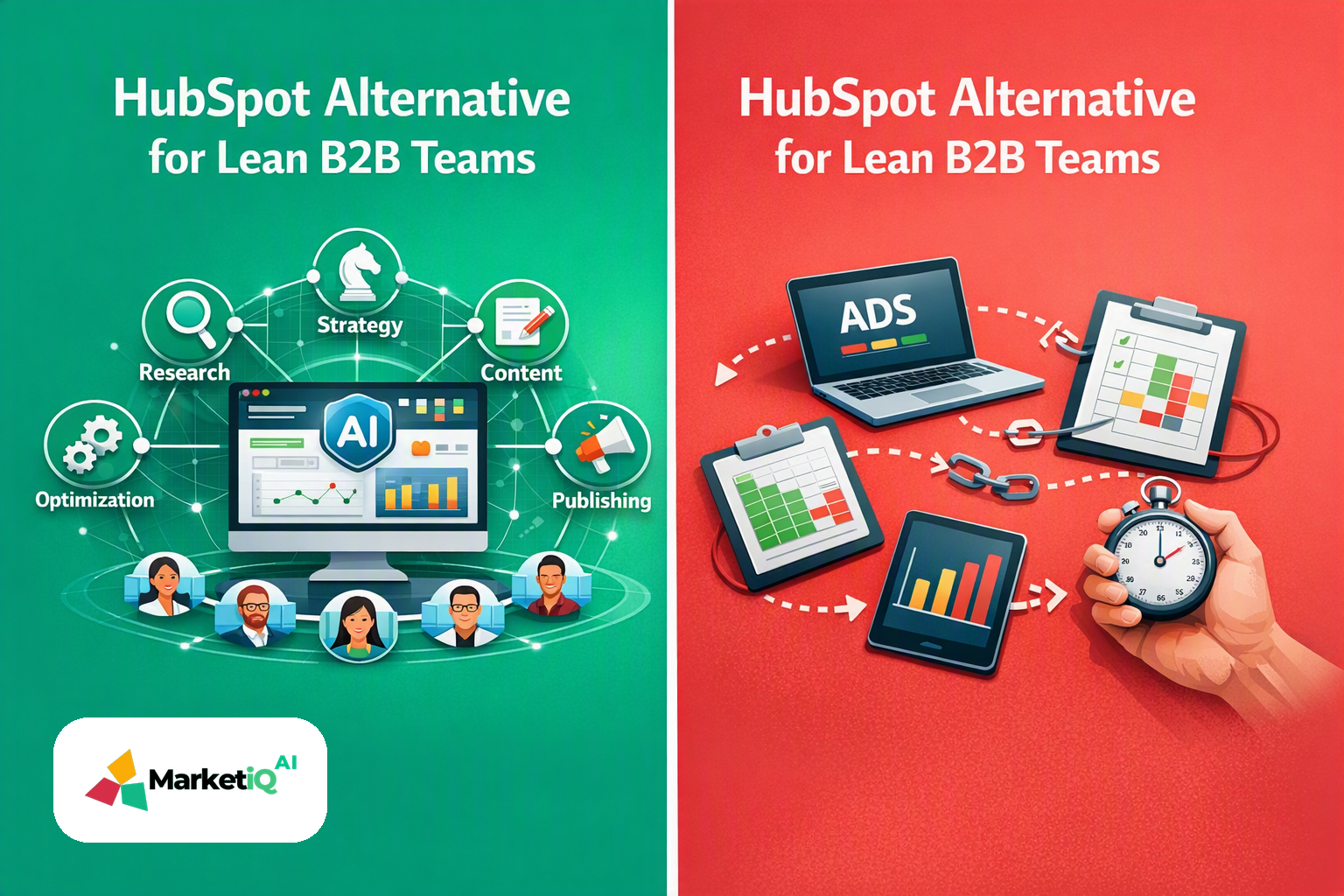
Choose a HubSpot alternative when your team spends more time coordinating marketing work than making GTM decisions.
HubSpot organizes customer records and campaigns. MarketiQ coordinates the research-to-activation operating loop.
That distinction matters when a 2–4 person marketing team is expected to research a market, sharpen positioning, produce content, secure approvals, publish across channels and learn from performance without a dedicated marketing operations owner.
If your main problem is managing contacts, campaign data and customer activity, HubSpot may be the right center of gravity. If your main problem is moving from market signal to approved execution without stitching together ten disconnected workflows, a governed GTM operating system may be the better fit.
The switching trigger is simple: choose a HubSpot alternative when your team is spending more time coordinating marketing work than making GTM decisions.
Why Early-Stage B2B Teams Look for a HubSpot Alternative
HubSpot is often introduced as a central system for customer records, campaigns and marketing activity. That can create useful structure as a company builds its demand engine.
But lean B2B SaaS teams commonly have a different bottleneck. Their work is distributed across research documents, positioning notes, AI writing tools, design tools, SEO platforms, social schedulers, ad platforms, spreadsheets and reporting systems. The problem is not a missing place to store another record. It is the chain of handoffs between insight and execution.
A typical campaign may require someone to:
- Find and interpret market evidence.
- Translate it into an audience, offer and message.
- Create several content assets.
- Route each asset through brand and stakeholder approval.
- Publish through the correct provider.
- Check whether the provider accepted the action.
- Connect the result to the next marketing decision.
When those steps live in separate tools, context gets lost. Approvals sit in chat threads. A scheduled post may be mistaken for a published post. Performance data arrives after the team has already moved on to another campaign.
That is the point at which a HubSpot alternative deserves consideration: when the team needs operating coordination, not another destination for campaign information.
What to Look for in a HubSpot Alternative
A useful comparison should focus on the work your team cannot reliably complete today. For a lean B2B SaaS marketing function, five criteria matter.
1. Research must connect to action
A research insight should carry its source, confidence and relevance into the campaign decision. Otherwise, research becomes a document that content creators may or may not read.
2. Content needs shared context
The system should preserve the audience, offer, positioning, voice, evidence and prior learning behind an asset. MarketiQ calls this shared context the Brand Brain. Product capability includes using that context across coordinated workflows so agents are not producing isolated outputs from disconnected prompts.
3. Automation needs approval gates
Useful automation does not mean every action runs without oversight. It means configured agents prepare work, identify what is required, pause for approvals or permissions and report the state of the workflow clearly.
4. Publishing needs provider confirmation
“Submitted” and “published” are different states. A dependable workflow records provider responses, delivery receipts and uncertain outcomes instead of treating an API request as proof that an asset reached its destination.
5. Performance must influence the next decision
Reporting at the end of a campaign is not the same as continuous learning. The operating context should carry observed performance into future strategy, content and experimentation decisions.
HubSpot vs. MarketiQ for Lean B2B Teams
MarketiQ is built around five connected stages: research, strategy, creation, activation and optimization. Its product capability is described as a coordinated system of 40 specialized AI agents, 54 approval-aware loops and 30+ GTM modules operating in one shared workspace.
The difference is therefore architectural.
| Decision area | HubSpot | MarketiQ |
|---|---|---|
| Primary operating center | Customer records, campaigns and related marketing activity | Research-to-activation GTM workflow |
| Content workflow | Supports campaign and marketing execution within its customer platform context | Coordinates research, strategy, content creation, approvals, activation and optimization |
| Specialist capacity | Central platform for teams and their configured processes | 40 specialized agents assigned across GTM work |
| Governance | Depends on team configuration and operating process | 54 approval-aware loops, with permissions and approval gates built into workflow orchestration |
| Brand consistency | Managed through the team’s processes and assets | Shared Brand Brain containing audience, offer, voice and accumulated learning |
| Publishing reliability | Depends on connected channels and team monitoring | Provider confirmations, delivery receipts and reconciliation of uncertain outcomes |
| Best fit | Teams prioritizing customer data and campaign management in a central platform | Lean teams prioritizing coordinated GTM execution across research, content, activation and learning |
This is not a claim that one platform replaces every function of the other. MarketiQ should be evaluated as an operating layer for GTM work, not as a reason to discard systems that already manage customer data or other essential records.
The strongest evaluation is a narrow one: take a real workflow from research brief to approved content to delivery reconciliation and compare the handoffs, approval points, evidence trail and time required.
Pricing and Total Cost of Ownership
A platform’s price is only one part of the decision. The operational cost sits in the work around it.
For a lean team, calculate:
- How many tools are involved in one campaign.
- How many manual handoffs occur before publication.
- How often someone checks whether a provider accepted the action.
- How much time is spent rebuilding context for each new asset.
- Whether performance learning is recorded and reused or left in a report.
- Which existing tools must remain connected after a new platform is adopted.
MarketiQ AI is free to start. The relevant question is not whether it creates a larger software category on your budget. It is whether one governed operating context reduces coordination overhead across the workflows you already run.
Do not compare tools using a feature-count spreadsheet alone. Compare one complete workflow, including the exceptions. A failed provider action, missing permission or incomplete evidence often reveals more about operational fit than a polished demo path.
How to Evaluate a Switch Without Disrupting Pipeline
Do not begin by moving every campaign, asset or system. Start with one repeatable workflow that currently crosses several tools.
A practical evaluation can follow this sequence:
- Select a current workflow, such as research to approved LinkedIn content.
- Document the existing steps, owners, tools, approvals and failure points.
- Define acceptance criteria for evidence, brand compliance, approval and delivery status.
- Recreate the workflow in a MarketiQ sandbox or scoped pilot.
- Compare the time spent coordinating, reviewing and reconciling the work.
- Record what the system completed, what required permission and where a human decision remained necessary.
This approach protects active pipeline while giving the team an observable basis for deciding. It also avoids the common mistake of buying automation before understanding which handoffs are actually slowing execution.
Choose HubSpot When Your Bottleneck Is Customer Data
Choose HubSpot when your team’s immediate priority is organizing customer records, campaign activity and the processes built around that customer platform. It can be the sensible choice when the organization already has a clear content and campaign operating model and needs a central system for managing marketing information.
Choose MarketiQ when your team’s immediate priority is coordinating the work before and after campaign management: evidence-backed research, strategy, content production, approval-gated activation, provider confirmation and performance learning.
For a funded B2B SaaS company with a small marketing team, the switching trigger is operational: if every campaign requires rebuilding context across tools and manually checking what happened after approval, evaluate MarketiQ as the GTM operating layer before adding another specialist or another disconnected point solution.
Request a workflow fit check. Bring one real research-to-activation process, and see where the handoffs, approvals and delivery states can be governed in one shared context.
This article describes practices and observations; it is not a promise of rankings, deliverability or revenue. Verify cited sources and their dates before making decisions.
Related reading
- 1MarketiQ AI vs HubSpotLinked from this article
- 2From GTM Tool Stack to GTM Execution System: A Launch-Week PlaybookLinked from this article
- 3MarketiQ AI vs HubSpotLinked from this article