MarketiQ AI vs HubSpot
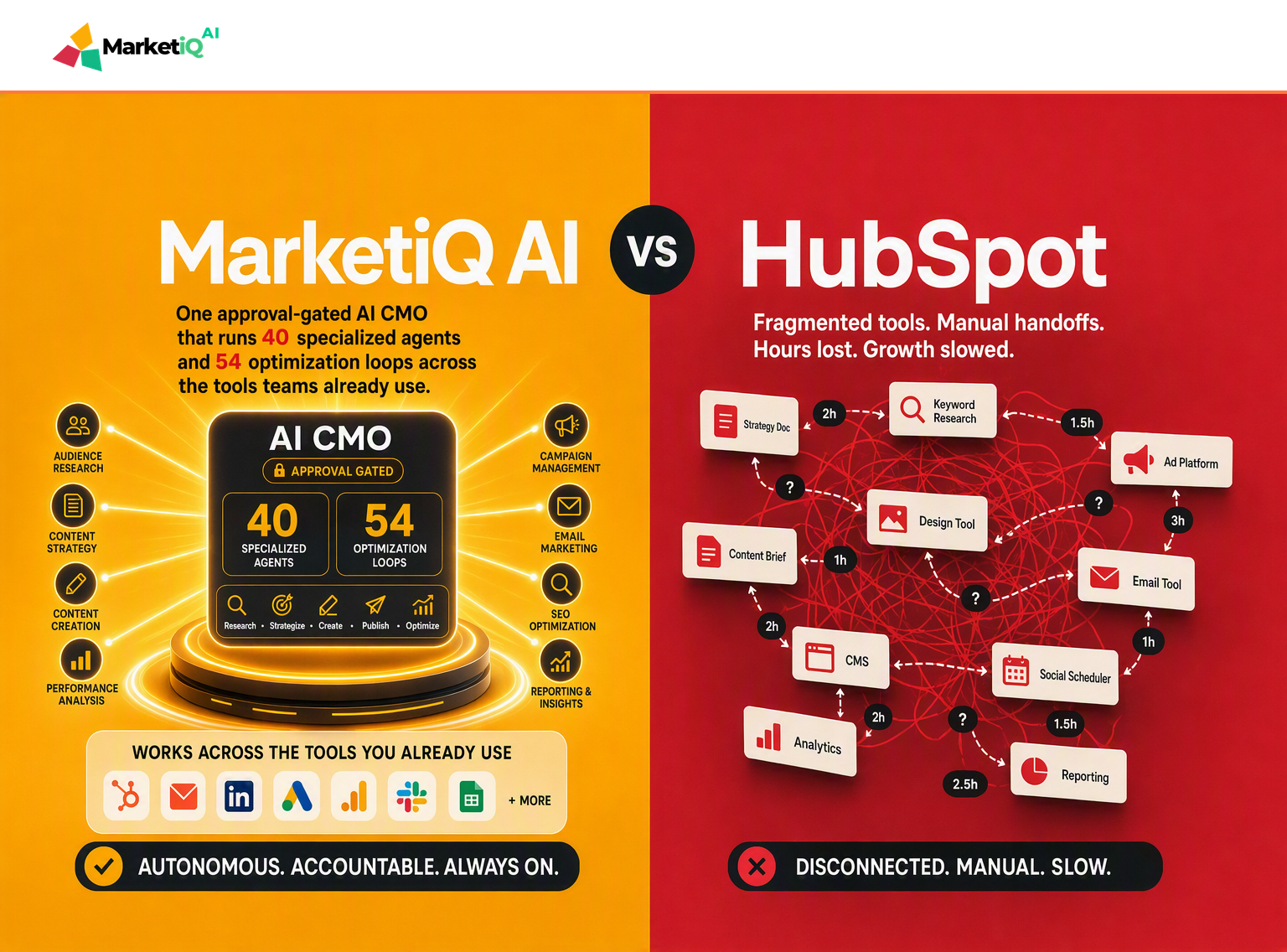
For a lean B2B SaaS team, the key question is simple: do you need a CRM, a GTM operating layer, or both?
If your team needs a system of record for contacts, opportunities, and deal reporting, HubSpot is the more natural fit. If your main constraint is coordinating research, strategy, content, approvals, publishing, and learning across a lean marketing team, MarketiQ AI is built for that operating layer.
The practical answer is often not replacement. HubSpot can remain the system for customer and deal data while MarketiQ AI coordinates the work that happens before and around those records. Validate current capabilities, integrations, and pricing on the MarketiQ AI product page before making a platform decision.
MarketiQ AI vs HubSpot: Quick Verdict
Choose HubSpot when your priority is managing customer records, opportunity stages, and CRM reporting in one established environment.
Choose MarketiQ AI when your priority is increasing GTM execution capacity without adding separate specialists for research, strategy, content, activation, and performance learning.
Choose both when you want HubSpot to remain the customer and deal system of record while MarketiQ AI coordinates the marketing workflow around it.
The distinction matters. A CRM records what is happening with contacts and deals. A GTM operating layer helps teams decide what to do next, produce the work, secure approval, activate it through connected providers, reconcile delivery, and feed observed results into the next decision.
What Are MarketiQ AI and HubSpot?
HubSpot is commonly used as a CRM-centered system for customer records, opportunity stages, and reporting. It is a strong choice when the central operating problem is visibility into contacts, deals, and revenue processes.
MarketiQ AI is a governed autonomous go-to-market operating system. Its AI CMO coordinates marketing work across five connected stages:
- Research: Gather source-linked evidence and record confidence.
- Strategy: Turn evidence into an audience, offer, campaign, and channel decision.
- Creation: Produce briefs, copy, creative direction, and channel assets using shared brand context.
- Approval-gated activation: Route work to a human reviewer, check permissions and consent, then activate approved work.
- Delivery reconciliation and learning: Record provider responses, confirm delivery status, measure observed performance, and inform the next recommendation.
The product is designed for teams that already have tools but lack a coordinated workflow across them. That makes it a different category of decision from buying a CRM.
Feature Comparison: MarketiQ AI vs HubSpot
| Decision area | HubSpot | MarketiQ AI |
|---|---|---|
| Core use case | Customer and deal records, opportunity stages, and CRM reporting | Coordinated GTM execution from research through activation and learning |
| Automation | Useful for workflows connected to CRM activity and records | Orchestrates specialized marketing work across research, strategy, creation, publishing, optimization, attribution, and repeatable loops |
| Content workflow | Can support marketing processes connected to the CRM | Uses shared brand context to move from evidence and strategy to review-ready content and channel assets |
| Governance | Depends on configured users, workflows, permissions, and review processes | Approval gates, permissions, consent checks, brand rules, evidence links, and explicit pauses for blocked actions |
| Reporting | Focused on records, pipeline, stages, and CRM activity | Focused on workflow status, provider responses, delivery reconciliation, performance evidence, and next learning decisions |
| Best starting point | A company standardizing customer and revenue data | A lean marketing team losing time to handoffs between tools and people |
The strongest difference is traceability across execution. A recommendation should connect to its source. Approved content should connect to the reviewer and permission check. A publishing action should show whether the provider accepted, rejected, or failed to confirm it. That is the operating gap MarketiQ AI is designed to address.
HubSpot wins when your team primarily needs a CRM foundation and a shared place to manage customer and opportunity information. MarketiQ AI wins when the bottleneck sits between the marketing plan and the evidence of what actually happened.
Ease of Use, Setup, and Support
A CRM implementation usually starts with data structure: records, fields, lifecycle stages, owners, pipelines, and reporting requirements. A MarketiQ AI evaluation should start with a workflow: for example, research brief to approved LinkedIn post to delivery reconciliation.
That difference changes the setup conversation. Instead of attempting to move every marketing process at once, define one workflow and its acceptance criteria:
- Which sources can research use?
- Who approves the strategy and final asset?
- Which connected provider can publish?
- What counts as submitted, accepted, uncertain, or failed delivery?
- Which performance evidence informs the next decision?
MarketiQ AI should pause when access, approval, consent, or evidence is missing. That is a feature of governed autonomy, not a setup failure. Confirm the available integrations, permissions model, onboarding process, and support terms directly with the vendor.
Pricing, Plans, and Total Cost of Ownership
No current MarketiQ AI or HubSpot pricing details were supplied for this comparison, so a responsible decision should not rely on guessed plan names or dollar amounts. Check both vendors' current pricing, usage limits, required modules, seats, implementation work, and integration costs.
Total cost also includes the operating work around the software. For a lean B2B SaaS team, measure:
- Time spent preparing research and campaign briefs
- Hours lost to manual handoffs and approval chasing
- Rework caused by inconsistent brand or audience context
- Time required to confirm whether a provider actually delivered an asset
- Reporting effort needed to turn performance data into the next decision
A lower software bill can still produce a higher operating cost if the team continues reconciling work across disconnected tools. A broader platform can also be wasteful if the team buys capacity it will not use. Run a scoped workflow test before committing to a large migration.
Which Platform Should You Choose?
Choose HubSpot when:
- Your immediate need is a CRM system for contacts, companies, opportunities, and deal stages.
- Sales and marketing need a shared record for customer and pipeline activity.
- Your main reporting problem concerns CRM visibility and opportunity management.
- You already have a functioning marketing workflow and need stronger customer-data coordination.
Choose MarketiQ AI when:
- A 2–4 person marketing team is covering research, strategy, content, distribution, and analytics at once.
- Campaign work is scattered across tools, documents, approval threads, and provider dashboards.
- You need more execution capacity without immediately hiring several specialists.
- Human approval, brand consistency, evidence links, and delivery status are non-negotiable.
- You want to test one research-to-approved-content-to-reconciliation workflow before expanding.
Choose both when:
- HubSpot already holds important customer and deal data.
- The marketing team needs a coordinated operating layer around that data.
- You want to improve GTM execution without discarding existing tools before proving replacement value.
How to Evaluate or Switch Platforms
Start with one live or representative workflow. Document the current path from research to decision, creation, approval, publishing, delivery confirmation, and measurement. Record every handoff and unresolved status.
Then run the same workflow in a MarketiQ AI sandbox or scoped evaluation. Compare the two paths on time, approval clarity, evidence traceability, provider status, and the quality of the next learning decision. Do not judge the system on generated copy alone. Judge whether the team can see what was proposed, why it was proposed, who approved it, what the provider did, and what should happen next.
For many B2B SaaS teams, the decision is straightforward: choose HubSpot when customer and pipeline records are the bottleneck; choose MarketiQ AI when coordinated GTM execution is the bottleneck; choose both when you need each system to do the job it was designed to do.
Validate MarketiQ AI's current capabilities and request a scoped workflow evaluation.
This article describes practices and observations; it is not a promise of rankings, deliverability or revenue. Verify cited sources and their dates before making decisions.
Related reading
- 1From Market Evidence to the Next GTM DecisionLinked from this article
- 2The GTM Loop an AI Marketing Copilot Should CloseLinked from this article
- 3AI GTM Platform Selection GuideLinked from this article