AI Marketing Automation: From Tasks to GTM Loops
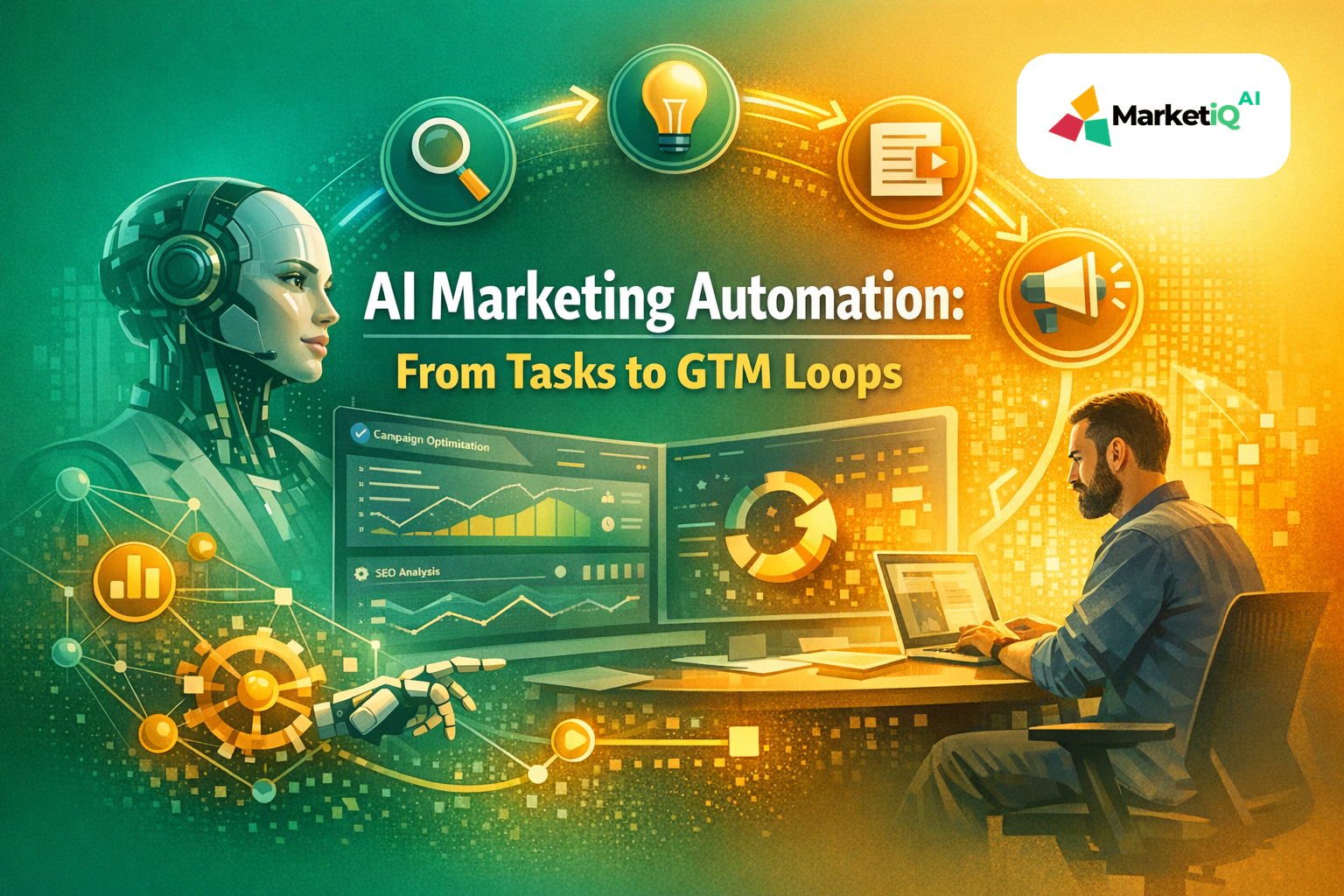
AI Marketing Automation: Tools, Strategies & Examples
AI marketing automation is moving beyond isolated tasks such as generating a headline, drafting an email or scheduling a social post. The more valuable shift is toward connected go-to-market workflows that research the market, shape strategy, produce assets, publish campaigns and learn from performance.
For lean B2B SaaS teams, this distinction matters. Adding another AI tool can increase the number of tabs, prompts and hand-offs your team manages. A connected AI marketing system should do the opposite: create one controlled loop from evidence to execution to optimization.
What Is AI Marketing Automation?
AI marketing automation uses artificial intelligence to support or execute recurring marketing activities with less manual coordination. Depending on the system, this can include market research, customer profiling, positioning, content creation, campaign planning, publishing, analytics and experimentation.
Traditional automation follows predefined rules: when a contact completes an action, trigger an email. AI marketing automation can work with less structured inputs. It can interpret research, identify patterns, draft recommendations, adapt messaging and prioritize next actions.
The strongest model is not “AI replaces the marketing team.” It is an AI CMO operating alongside the team. AI agents handle research and execution across defined workflows. Humans set goals, supply context, approve sensitive decisions and maintain governance.
That combination creates governed autonomy: more execution capacity without surrendering strategic control.
How AI Marketing Automation Works
A useful AI marketing automation workflow connects five stages:
- Research: Agents collect and organize market, audience, competitor and channel information.
- Strategy: The system turns evidence into ICP definitions, positioning, messaging, campaign priorities and channel plans.
- Creation: Content and campaign assets are generated using shared brand context rather than disconnected prompts.
- Distribution: Approved work is scheduled and published across the selected marketing channels.
- Optimization: Performance and attribution signals inform experiments, recommendations and the next planning cycle.
This structure is important because isolated automation creates isolated outputs. A content generator may produce an acceptable article, but it does not necessarily know which audience, positioning or revenue goal the article supports. A publishing tool can ship a campaign, but it may not understand what the next campaign should change.
Connected agents preserve context across the funnel. Research informs strategy. Strategy informs content. Published work creates performance data. Performance data improves future decisions.
MarketiQ AI is designed around this operating-system model. Its AI CMO and 45 AI agents support research, strategy, creation, publishing and optimization through 26 optimization loops. Teams configure data sources, permissions and approval rules; the system then runs scheduled workflows within those guardrails.
Benefits of AI Marketing Automation for Marketing Teams
Faster campaign execution
A lean SaaS team can move from a campaign brief to a coordinated set of assets without manually transferring context between research documents, planning tools, writing assistants, design systems, calendars and analytics dashboards.
The goal is not simply to create more content. It is to reduce the time between identifying an opportunity and testing a message in market.
Fewer operational hand-offs
When strategy, production and distribution live in separate systems, every hand-off creates delay and risk. Details get lost. Teams repeat instructions. Approvals become difficult to track.
A connected workflow gives each agent access to the relevant brand, audience and campaign context while keeping approval gates visible to human reviewers.
More consistent execution
A shared brand memory can help keep messaging, tone, audience definitions and campaign priorities aligned across assets and channels. This is particularly useful when a small team is producing content for multiple funnel stages at once.
Better learning across the funnel
The most valuable output of automation is not a single asset. It is a faster learning cycle. When results from campaigns, experiments and channels feed back into planning, the team can improve decisions instead of repeating the same production process.
Key AI Marketing Automation Features
When evaluating an AI marketing automation tool, look for connected capabilities rather than a long list of isolated features.
Research and market intelligence: The system should help organize customer, competitor, persona and channel evidence before recommendations are made.
AI CMO orchestration: Strategy should connect business goals to ICPs, positioning, messaging, channel plans and campaign priorities.
Brand context: A shared Brand Brain or equivalent memory should give agents consistent access to approved brand information, guidelines and prior learning.
Multi-format creation: The platform should support the formats your team actually uses, such as posts, emails, campaign copy, decks and creative briefs.
Cross-channel publishing: Approved assets should move into distribution workflows without requiring manual copying between disconnected calendars and platforms.
Analytics and attribution: Performance signals need to be connected to campaigns and decisions, not trapped in a reporting dashboard that no workflow can use.
Approval controls: Teams should be able to define which actions are automatic and which require human review. Permissions, data connections and guardrails are essential before scheduled loops run continuously.
AI Marketing Automation Examples and Workflows
Consider a B2B SaaS company preparing to launch a new workflow product.
First, research agents organize the company’s target accounts, buyer pain points, competitor positioning and relevant channel signals. The AI CMO uses that evidence to recommend an ICP, a core message, campaign angles and a channel plan.
Composer and designer agents then create the campaign assets using the company’s brand context: a landing page brief, email sequence, LinkedIn posts, sales enablement copy and creative directions. The marketing lead reviews claims, positioning and final assets before approval.
Publishing agents schedule the approved campaign. Analytics and attribution workflows monitor engagement, lead activity and downstream signals. If one message earns stronger response from the target audience, the system can recommend new variations, update the content plan or prioritize a follow-up experiment.
The same model applies to ongoing demand generation. A team can run a weekly content loop, a product launch loop, an ABM campaign loop or a quarterly GTM planning loop. Each workflow has a defined objective, inputs, approval points and feedback signals.
The improvement comes from the connection between workflows. A campaign result can influence future messaging. Research can change the content calendar. Attribution can change channel priorities. Marketing becomes a learning system rather than a queue of unrelated tasks.
How to Choose and Implement AI Marketing Automation
Start with the workflow, not the tool. Map how a real campaign currently moves from research to reporting. Identify where work is duplicated, where context is lost and where approvals create bottlenecks.
Then choose one measurable use case. For a small B2B SaaS team, that might be a full-funnel launch, a recurring content engine or an ICP-to-campaign workflow. Define the inputs, expected outputs, owner, approval gates and success signals before activating automation.
Connect only the data and channels required for that use case. Confirm permissions, brand rules and review requirements. Begin with approval-gated execution, inspect the outputs, and expand autonomy only when the workflow is reliable.
Good AI marketing automation practices include:
- Keep humans accountable for positioning, claims, compliance and high-impact decisions.
- Give agents structured brand and audience context instead of relying on one-off prompts.
- Measure business signals, not just asset volume.
- Review recommendations for source quality and strategic fit.
- Create feedback loops so results change future planning.
- Treat autonomy as configurable, not absolute.
AI marketing automation has limitations. It cannot compensate for unclear positioning, poor data, weak offers or missing permissions. It can also produce confident but unsuitable recommendations when context is incomplete. Human review remains necessary wherever accuracy, reputation, compliance or strategic judgment matters.
The practical takeaway: choose a system that connects research, strategy, creation, publishing and optimization into one governed loop. Explore autonomous GTM workflows with MarketiQ AI, free to start, and see how an AI CMO can help your team execute with fewer hand-offs and a clearer path from market evidence to measurable learning.
- #AI
- #Marketing
- #Automation
- #Tools
- #Strategies
This article describes practices and observations; it is not a promise of rankings, deliverability or revenue. Verify cited sources and their dates before making decisions.
Related reading
- 1MarketiQ vs HubSpot Lean SaaS GTM ComparisonLinked from this article
- 2MarketiQ vs Clay comparisonLinked from this article
- 3Stop Rebuilding Campaign Briefs From ScratchLinked from this article