Jasper and Copy.ai Alternatives Beyond Content
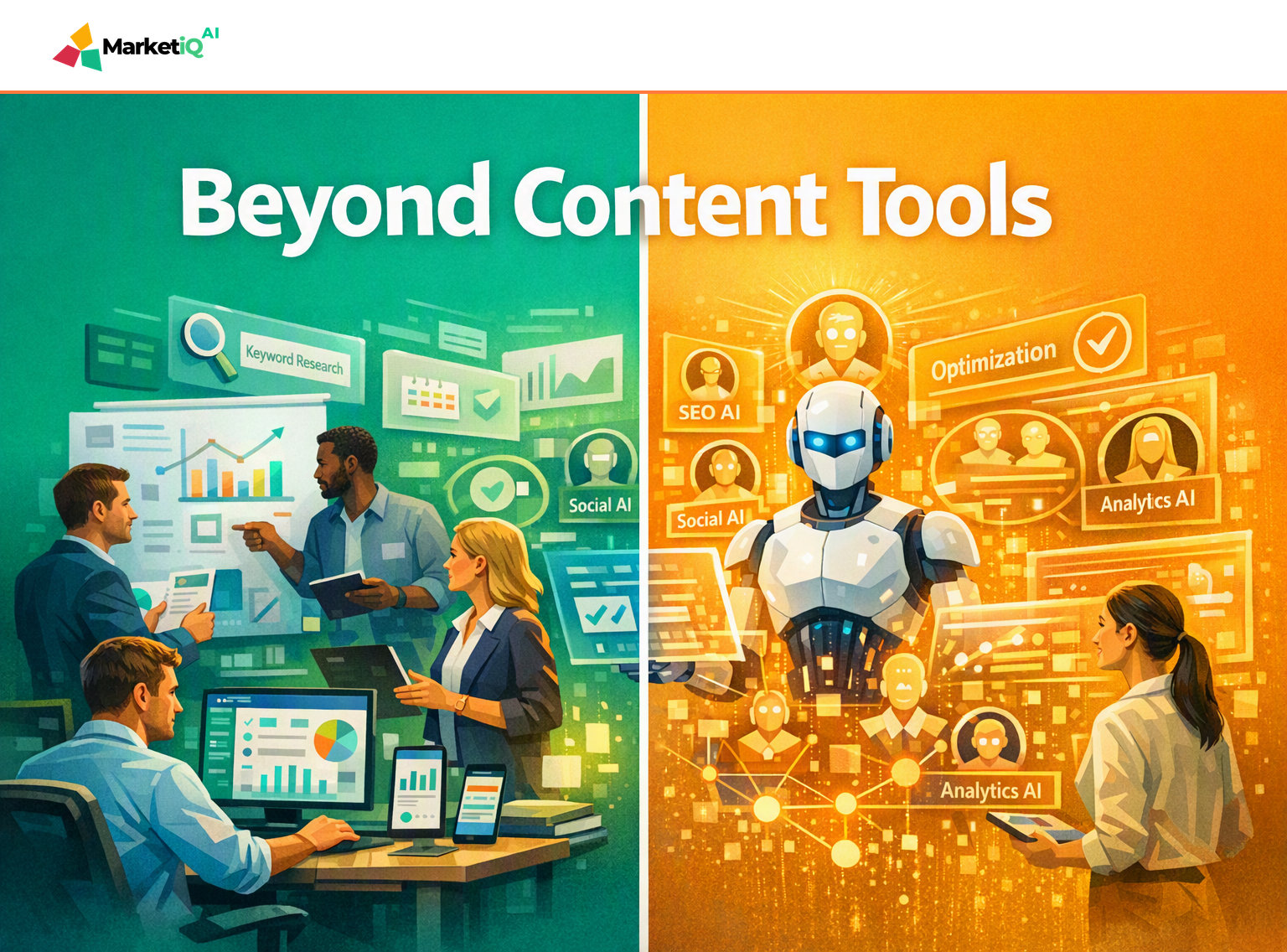
Before comparing Jasper and Copy.ai prices, ask what happens after the draft.
If you're searching for cheaper alternatives to Jasper and Copy.ai that also handle publishing, analytics, attribution and strategy, compare the workflow before comparing the subscription price. A writing tool may reduce drafting time while leaving your team responsible for campaign planning, approvals, distribution, reporting and optimization.
MarketiQ AI takes a different position: it acts as an approval-controlled go-to-market operating system for lean teams, connecting research, strategy, content production, publishing and optimization in one loop. It is free to start and includes an AI CMO coordinating 37 specialist agents across 46 autonomous loops.
That does not make it the right choice for every team. The right choice depends on the job you need the software to perform.
What to Look for in a Jasper or Copy.ai Alternative
Start with the work that happens after the draft. A useful comparison should answer five questions:
- Can it turn evidence into a marketing plan? Look for market research, ICP definition, positioning, messaging and channel planning, not only prompts and templates.
- Can it move approved work into distribution? Publishing should include scheduling, channel coordination and visible approval gates.
- Can it explain performance? Analytics should connect activity to agreed indicators, not leave someone consolidating screenshots and spreadsheets.
- Can it feed learning into the next campaign? Optimization requires experiments, attribution and a way to update future decisions with performance signals.
- Can humans control the system? Permissions, brand context, review steps and delivery status matter when software touches live channels.
This is the dividing line between a content-generation tool and a GTM operating layer. The former helps produce an asset. The latter coordinates the decisions and handoffs around that asset.
Jasper vs. Copy.ai vs. a Full GTM Operating System
Jasper and Copy.ai are the named tools most buyers encounter when looking for AI-assisted marketing work. But a responsible comparison should not invent current pricing, packaging or capabilities. Those details change and should be checked in each vendor's current documentation.
The more durable comparison is functional coverage:
| Evaluation area | Jasper or Copy.ai evaluation | MarketiQ AI |
|---|---|---|
| Content generation | Confirm the formats, brand controls and workflows included in the current plan | Composer, designer, director and planner agents produce campaign content using shared brand context |
| Strategy | Confirm whether your plan includes research, ICP work, positioning and channel planning | The AI CMO turns research into positioning, messaging, channel plans and GTM direction |
| Publishing | Confirm supported channels, scheduling, approval steps and delivery status | Publishing agents distribute approved work across marketing channels with human checkpoints |
| Analytics | Confirm which performance data is available and how reporting is configured | Performance signals are tracked as part of the connected GTM workflow |
| Attribution | Confirm whether pipeline and revenue links require separate tools or setup | Revenue attribution is part of the optimization and measurement workflow |
| Optimization | Confirm whether results change future planning or remain in reports | Optimization loops feed experiment and performance signals back into the Brand Brain |
| Governance | Confirm permissions, approvals and audit visibility | Data sources, permissions, guardrails and approval gates remain explicit |
The table is intentionally cautious. A tool should not receive credit for a capability until your team has verified how it works in the specific plan and workflow you are considering.
Which Options Actually Handle Publishing, Analytics and Strategy?
For a team comparing Jasper and Copy.ai alternatives, there are three practical categories.
1. A writing-focused tool
Choose this route when the bottleneck is drafting. You already have a clear strategy, a functioning content calendar, reliable publishing processes and someone who owns analytics. In that environment, a writing assistant can be a sensible, focused purchase.
The trade-off is operational. Research, planning, approvals, distribution and reporting stay elsewhere. The software may be cheaper than a broader system, but the team still pays the coordination cost in time and handoffs.
2. A connected collection of point solutions
This approach can work when you need deep functionality in a specific area, such as analytics, email delivery or attribution. It also gives experienced operators more control over individual components.
The cost is coordination. Someone must maintain integrations, reconcile statuses, preserve brand context and decide which performance data changes the next campaign. Adding another tool can reduce one task while increasing the number of systems a lean team must manage.
3. A governed GTM operating system
MarketiQ AI is built for the third case. Its AI CMO coordinates research, strategy, creation, publishing and optimization through one operating context. The Brand Brain gives specialist agents shared information about the company, audience and brand, so the team does not need to re-brief every workflow from scratch.
Autonomy is bounded. Teams configure data sources, permissions and guardrails. Approval-gated work pauses for human review before it moves forward. That makes the system appropriate for teams that want more execution capacity without handing over budget judgment or live publishing decisions.
The strongest fit is a 2–10-person B2B SaaS marketing team that needs to launch and learn faster but does not want to add separate specialists for research, content, demand generation, operations and analytics.
How to Choose the Right Tool for Your Budget and Workflow
Use a simple test before switching tools. Map one campaign from research to pipeline review and record every handoff.
Capture:
- Where the initial research lives
- Who turns evidence into the campaign brief
- How content and creative are produced
- Where approvals happen
- Who publishes each asset
- How results are collected
- How attribution is checked
- When performance changes the next decision
Then estimate the cost of coordination. Include copy-pasting, formatting, status checks, approval chasing, reporting and rework. A lower subscription price does not necessarily produce a lower operating cost if those tasks remain manual.
For a fair pilot, choose one bounded workflow. Define a baseline for time-to-first-campaign, approval latency, production throughput and the leading indicators that matter for the campaign. Review the evidence at day 7 and day 14. Do not begin with a claim that the tool will produce a specific amount of revenue.
Use a writing-focused tool when:
- Your strategy and channel plan already exist.
- Publishing and analytics are working well.
- Draft production is the main constraint.
Use a point-solution stack when:
- One specialized capability is business-critical.
- Your team has the operations capacity to maintain the connections.
- You need granular control over separate systems.
Use MarketiQ AI when:
- Research, planning, production, publishing and optimization are split across too many tools.
- A small team needs more GTM capacity without hiring every specialist.
- You want autonomous workflows with visible permissions, guardrails and approvals.
- You need performance learning to feed the next campaign instead of ending in a report.
Frequently Asked Questions About Jasper and Copy.ai Alternatives
What is the cheaper alternative to Jasper or Copy.ai?
There is no responsible answer without comparing current plans, usage limits and required integrations. The cheaper subscription may not be the cheaper operating model if your team still manages strategy, publishing, analytics and attribution manually.
Can a content-generation tool replace a marketing operating system?
Only when your team already owns the surrounding work. If research, campaign planning, approvals, publishing and optimization are separate bottlenecks, producing more drafts will not remove them.
Does MarketiQ AI publish content automatically?
Publishing runs within configured permissions and approval controls. Approved work can move through publishing workflows, while approval-gated steps remain visible for human review. Autonomous execution is bounded by the data, permissions and guardrails your team sets.
Is MarketiQ AI a replacement for every marketing tool?
No. The relevant question is whether it can coordinate the workflow you need to improve. Some teams will keep specialist systems for particular channels or data requirements. MarketiQ AI is designed to connect the research-to-pipeline operating loop and reduce manual handoffs around it.
What should a lean B2B SaaS team test first?
Test one campaign workflow with a defined owner, objective, ICP and approval process. Measure execution time and learning quality before expanding scope.
Final Recommendation: Match the Tool to the Full Marketing Job
Choose Jasper or Copy.ai when the primary need is content production and the rest of your GTM process is already under control. Choose a specialized point solution when a single function requires depth your broader system cannot provide.
Choose MarketiQ AI when the expensive problem is the space between functions: research to strategy, strategy to creation, creation to publishing and publishing to optimization. Start with one bounded workflow, keep human approval in the loop and measure the handoffs you remove.
Identify the most expensive handoff in your current stack, then see whether a connected GTM operating loop can eliminate it.
This article describes practices and observations; it is not a promise of rankings, deliverability or revenue. Verify cited sources and their dates before making decisions.
Related reading
- 1Best Autonomous GTM OS for Lean B2B StartupsLinked from this article
- 2The Operating Loop Decision for Lean B2B SaaS TeamsLinked from this article
- 3One Positioning Doc, One Campaign SystemLinked from this article