Choosing a B2B SaaS Attribution Model
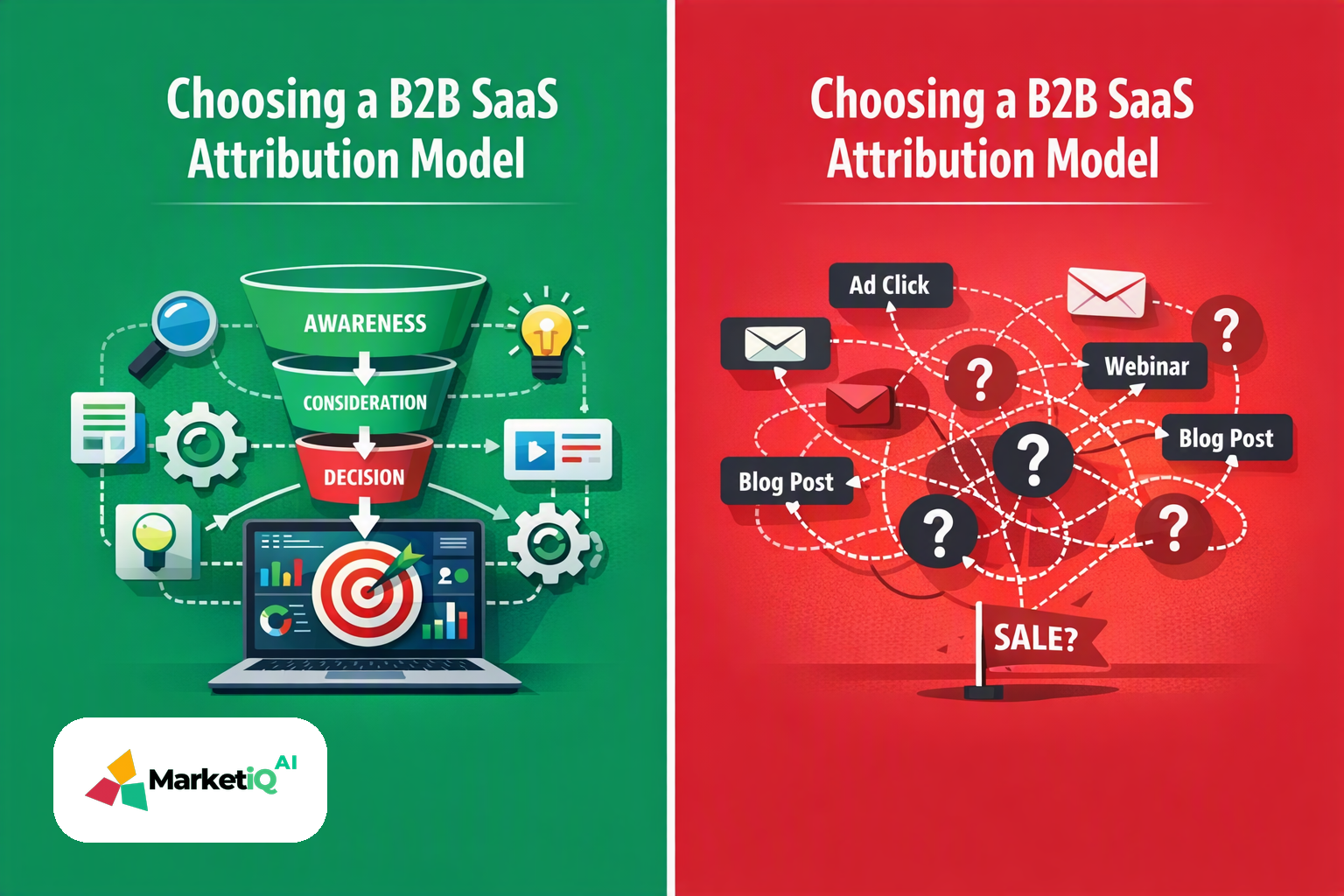
Your B2B SaaS team doesn’t need a more complex attribution model—it needs one you can validate.
A funded B2B SaaS company with one to five marketers rarely has an attribution problem because it lacks another dashboard. It has one because research, campaigns, publishing, CRM updates and pipeline reporting happen in different systems.
That makes the best marketing attribution model for B2B SaaS pipeline the one your team can explain, validate and use for the next decision.
For a lean team managing 8–15 disconnected tools, start with observable pipeline stages. Track which contacts or accounts entered a defined stage, when they entered it, and which approved marketing activities preceded that movement. Add model complexity only when your data can support it.
What marketing attribution means for B2B SaaS
Marketing attribution assigns credit for a business outcome, such as a form submission, qualified opportunity or closed deal, to one or more marketing touchpoints.
That sounds precise. B2B buying journeys rarely are.
A prospect may read a comparison page, attend a webinar, see a LinkedIn post, speak with sales, return through branded search and involve several people from the same account before an opportunity is created. An attribution model organizes the available evidence. It does not automatically prove that a touchpoint caused pipeline.
That distinction matters. A model can show that a channel was present before an opportunity. Validation asks a harder question: did the activity contribute enough to justify the next investment?
For a small B2B SaaS team, attribution should support decisions such as:
- Which campaign should receive another week of execution?
- Which audience or message deserves a new experiment?
- Which channel has enough observed evidence to keep testing?
- Where is the handoff from marketing activity to pipeline breaking?
The attribution models, compared by decision
| Model | Business question it answers | Minimum data required | Where it can mislead | Best starting point |
|---|---|---|---|---|
| First-touch | What first brought this person or account into our known funnel? | Contact identity, first recorded source and a defined conversion event | It gives early awareness all the credit, even when later activities created buying intent | Use for channel discovery when source capture is reliable |
| Last-touch | What was present immediately before conversion or opportunity creation? | Timestamped touchpoints and a clearly defined conversion event | It over-rewards the final form, meeting or campaign interaction and ignores earlier demand creation | Use for operational reporting around a specific conversion |
| Linear | Which touches were present across the recorded journey? | Ordered, timestamped touches across the chosen attribution window | It treats every interaction as equally valuable, even when some were passive or redundant | Use as a neutral baseline when no stronger weighting is defensible |
| U-shaped | Did the first known touch and the lead-conversion touch both matter? | Reliable first-touch and lead-conversion timestamps, plus middle touches | It concentrates credit on two milestones and can undervalue activities between them | Use when those two funnel transitions are consistently captured |
| W-shaped | How did first touch, lead creation and opportunity creation contribute? | Reliable contact history, lead or qualification events and opportunity timestamps | It appears rigorous while still depending on incomplete contact and account activity | Use when opportunity-stage data is stable enough to reconcile |
| Time-decay | Which touches occurred closest to the outcome? | Timestamped touches and a chosen decay rule | It assumes proximity means influence, which can favor late-stage activity and sales-assisted events | Use for shorter, high-intent cycles with enough historical data |
| Position-based | Should the first and last touches receive most of the credit, with the rest shared? | Reliable journey boundaries and a documented weighting rule | It resembles U-shaped attribution but usually applies a broader first-and-last weighting across the journey | Use only when your team can explain why the selected weights reflect the buying process |
| Account-level | Which marketing activities reached an account that later progressed? | Account identity resolution, contact-to-account mapping, activity history and pipeline stages | It can imply account influence without proving which person or activity changed the decision | Use for multi-person B2B buying groups when account matching is dependable |
U-shaped and position-based models are often treated as the same. They aren't. U-shaped attribution normally emphasizes two named funnel milestones, such as first touch and lead creation. Position-based attribution is a broader weighting approach that assigns high value to the beginning and end of a recorded journey, then distributes the remainder according to a stated rule. The labels matter less than the rule your team can audit.
How to choose a model for a lean SaaS team
Start with the business question, not the most sophisticated formula.
If leadership needs to know which source first creates identifiable demand, first-touch may be enough. If the immediate question is what preceded opportunity creation, last-touch provides a narrow operational view. If several people from one company influence the deal, account-level analysis may be more useful than pretending every journey belongs to one contact.
The minimum viable setup is usually simpler than teams expect:
- Define the pipeline stages you will observe, such as known lead, qualified lead, opportunity and closed-won.
- Choose one attribution window and document it.
- Capture source, campaign, contact, account and timestamp fields.
- Record both positive and uncertain outcomes, including missing identity or incomplete provider data.
- Compare the model's output with what sales and marketing can actually verify.
For the ICP MarketiQ AI serves, the starting choice should usually be first-touch, last-touch or a transparent multi-touch baseline connected to observable pipeline stages. A team with no dedicated marketing operations owner cannot maintain a model that depends on hidden assumptions, inconsistent lifecycle definitions and manual reconciliation across every tool.
Complexity becomes useful when it changes a decision. If U-shaped, W-shaped and position-based reports all produce different rankings but nobody can explain why, the problem is not a lack of models. The underlying evidence needs work.
How attribution fits a continuous GTM loop
Attribution should not sit at the end of marketing as a reporting exercise. It should connect research, strategy, creation, publishing, analytics and experimentation.
Consider a MarketiQ AI workflow, shown as a product workflow rather than a customer result:
A research agent gathers market signals and attaches source evidence to an insight. A strategy stage turns that evidence into an audience, message or campaign recommendation. The Brand Brain supplies the approved context for the offer, audience and voice.
The content is drafted, then routed through the configured approval gate. The reviewer sees the proposed asset, requested action, provider connection and required permission. No approval means no consequential publishing action.
After approval, the asset is submitted through the connected provider. The workflow records the delivery state, such as submitted, accepted, uncertain or failed, rather than treating a send request as proof of publication. Delivery receipts and provider responses support execution reconciliation.
Analytics then connects the activity to the pipeline stages the team has chosen to observe. The result is not an unsupported claim that the campaign caused revenue. It is a traceable record of what evidence informed the recommendation, what was approved, what was delivered, what stage movement was observed and what confidence the team should place in the finding.
That finding can inform the next recommendation. Continue the message, revise the audience, test another channel or stop the activity. The important property is the loop: evidence, decision, approval, delivery, observation and learning.
Implementation checklist and FAQ
Before choosing a model, answer these questions:
- What event counts as a qualified pipeline stage?
- Are contacts mapped reliably to accounts?
- Can each provider confirm whether an asset was accepted or rejected?
- Are source and campaign fields preserved when a person returns later?
- Which actions require human approval?
- What evidence would cause the team to change the next recommendation?
Is last-touch attribution bad for B2B SaaS?
No. It is useful when the question is operational and narrow, such as which activity preceded a recorded conversion. It becomes misleading when treated as a complete account of demand creation.
Should a small team use multi-touch attribution?
Only if the team can maintain consistent touchpoint, identity and stage data. A transparent linear baseline is often more defensible than a weighted model nobody can validate.
Is attribution the same as incrementality?
No. Attribution allocates observed credit. Incrementality asks what would have happened without the activity. Treat attribution as directional evidence unless the team has a stronger validation design.
When should we use account-level attribution?
Use it when multiple people from the same buying group interact with marketing and account identity resolution is reliable. Do not use it to hide missing contact-level data.
The practical recommendation is direct: choose first-touch when you need a defensible acquisition view, last-touch when you need a conversion view, linear when you need a transparent baseline, and account-level when the buying process is clearly multi-person. Choose U-shaped, W-shaped, time-decay or position-based models only when their additional assumptions can be tested against stable data.
Start with the pipeline stages your team can observe. Then connect each approved activity, delivery receipt and measured outcome to the next GTM decision.
If your current workflow spans disconnected tools and manual approval threads, request a MarketiQ AI workflow fit check. Start with one path: research to approved content to delivery reconciliation.
This article describes practices and observations; it is not a promise of rankings, deliverability or revenue. Verify cited sources and their dates before making decisions.
Related reading
- 1Governed Pipeline AttributionLinked from this article
- 2Close the Campaign-to-Revenue Handoff Without Losing the EvidenceLinked from this article
- 3HubSpot Alternative for Lean B2B TeamsLinked from this article