The GTM Loop an AI Marketing Copilot Should Close
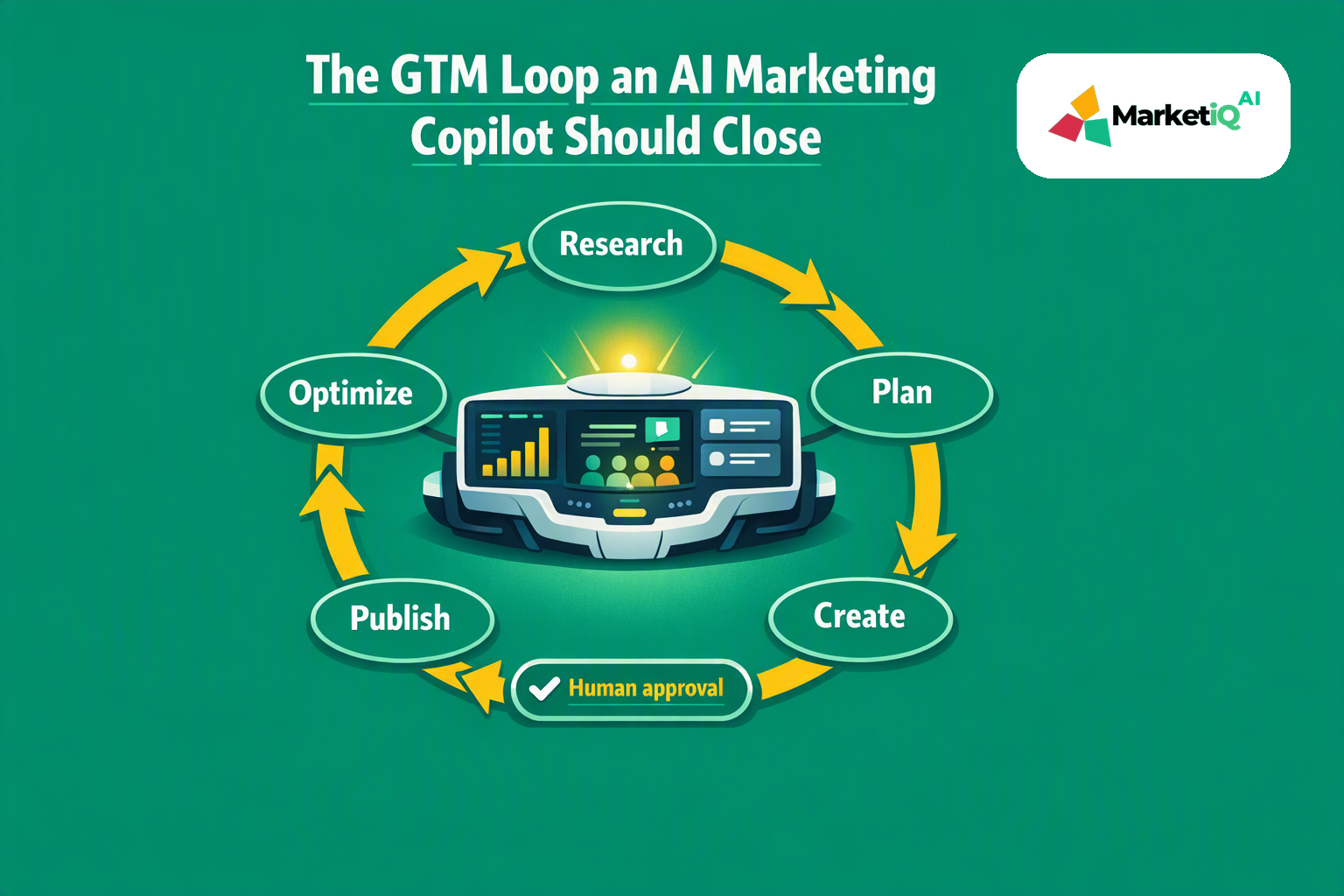
The missing feature in an AI marketing copilot is not better drafting—it is a traceable, approval-gated GTM loop.
A marketing team can have research, strategy, content, publishing and analytics in place and still lose the thread between them.
An insight sits in a research document. A campaign brief lives in another tool. Drafts wait for approval in Slack. Publishing happens in a social scheduler. Reporting arrives later, disconnected from the decision that created the work.
MarketiQ AI is built for the missing connection: one approval-gated GTM loop that moves from evidence to strategy, content, publishing and optimization, with a traceable record of what happened at each stage.
That is the difference between an AI marketing copilot and an AI CMO operating inside a governed go-to-market operating system.
What an AI marketing copilot should connect
A basic copilot helps with a task. It may summarize research, draft a post or suggest campaign ideas. Those outputs can be useful, but they stop before the operational questions begin:
- Which evidence shaped the recommendation?
- What context did the draft use?
- Who approved the action?
- Was the asset submitted, accepted or rejected by the provider?
- What did the result teach the next campaign?
A useful AI marketing copilot research publishing reporting workflow must preserve those connections. Research should influence a decision. The decision should create an asset. The asset should pass through permissions and approval gates. Publishing should produce a delivery state. Reporting should feed the next decision.
MarketiQ AI coordinates that workflow as an AI CMO. Its 37 specialist agents are designed to handle distinct marketing responsibilities across research, strategy, creation, publishing and optimization. Its 46 autonomous loops provide the operating structure for recurring work after data sources, permissions and guardrails are configured.
The system can run scheduled work, but humans retain approval and control where the workflow requires it.
1. Research creates evidence
The loop starts with market evidence, not a blank prompt.
Research agents can organize inputs from relevant channels, audiences and market signals into usable findings. The goal is to give the AI CMO a working view of the market: who the company is targeting, what those people care about, which messages are being tested and what prior activity has already shown.
That context is held in the Brand Brain, the shared marketing memory used to keep later work connected to the original evidence and brand requirements.
A research finding should not remain a paragraph in a report. It should be traceable to the recommendation it informs. For example, a market observation can support a positioning choice, a campaign angle or a content brief. When the source is incomplete or uncertain, the workflow should surface that limitation instead of presenting an unsupported conclusion as fact.
This is where governed autonomy begins. Agents can organize and interpret inputs, but the quality of the output still depends on connected data, defined permissions and reviewable evidence.
2. Strategy turns evidence into a decision
Research becomes valuable when it changes what the team does next.
The AI CMO can use the shared context to develop positioning, audience definitions, messaging, channel plans and campaign direction. Strategy is no longer assembled manually by copying findings from one tool into another. The recommendation is produced inside the same operating context that contains the evidence, brand rules and previous decisions.
That does not mean every recommendation should execute automatically. A strategy decision may need review from the VP of Marketing, founder, sales leader or another assigned owner. MarketiQ AI treats that approval as part of the workflow rather than an external interruption.
The practical output is a decision record:
- The recommendation and the audience it serves
- The evidence or context behind it
- The proposed channel and asset type
- The reviewer responsible for approval
- The next action if approved, rejected or returned for revision
A lean B2B SaaS marketing team can then spend its time judging the decision instead of reconstructing how the decision was made.
3. Creation uses the same context
Once a direction is approved, creation should not restart from zero.
The Brand Brain gives composer, designer, director and planner agents access to the relevant audience, offer, voice, evidence and campaign context. That lets the system produce connected work across formats, such as social posts, emails, campaign assets and supporting content, without repeating the same briefing in every tool.
This matters because isolated AI outputs create isolated review work. A post can sound on-brand while missing the campaign objective. An email can follow the offer while contradicting the approved positioning. A creative can be polished while relying on a claim that the research does not support.
A connected operating system gives reviewers more than a finished draft. It gives them the context needed to approve the draft responsibly.
MarketiQ AI's product capability is to coordinate this production workflow through its specialist agents and shared Brand Brain. The available product information does not establish independent customer outcomes, so the useful test is operational: can the system show where the asset came from, which rules it followed and what decision it supports?
4. Approval gates control publishing
Autonomous execution without permissions is a liability. Governed execution has a clear handoff between recommendation, approval and action.
Before publishing, the workflow can pause for human review. The reviewer can approve the asset, request changes or reject the action. Permissions and guardrails define what the system is allowed to do, which channels it can access and which steps require explicit authorization.
After approval, publishing agents distribute the approved work through the configured marketing channels. The important record is not only the content itself. It is the delivery receipt.
A delivery receipt should make the state visible. Was the asset submitted? Was it accepted by the provider? Is the result uncertain? Did the action fail? Those states prevent a common reporting error: treating a scheduled or attempted action as if it definitely reached its destination.
This is the operational distinction between a content generator and a GTM operating system. One creates an artifact. The other tracks the artifact through permission, approval, activation and delivery reconciliation.
5. Reporting turns activity into learning
Reporting should answer more than how many assets were created or published.
The useful question is whether the work produced a signal that should change the next decision. Performance data, attribution inputs and experiment results need to return to the same context used for research and strategy. That creates a closed loop:
- Research identifies evidence.
- Strategy converts evidence into a decision.
- Creation produces approved assets.
- Publishing records what was attempted and accepted.
- Reporting connects activity to observed signals.
- Optimization updates the next cycle.
MarketiQ AI is designed to connect these stages so the Brand Brain can support ongoing planning and optimization. The product capability is the workflow and its traceability. It should not be confused with a guaranteed pipeline result or independently validated performance improvement.
For a B2B SaaS team, this makes the system easier to evaluate. Start with one workflow, such as research to approved LinkedIn content to delivery reconciliation. Define what counts as complete. Track the time, approvals, delivery states and learning produced. Then decide whether the loop is ready to expand.
The best AI marketing copilot is an operating loop
The category is crowded with tools that draft, summarize, enrich or schedule. Those capabilities can help, but they leave the hardest work to the team: moving context between systems, checking permissions, confirming delivery and connecting results back to decisions.
MarketiQ AI takes a different position. It acts as an AI CMO inside a governed GTM operating system, coordinating 37 specialist agents and 46 autonomous loops across research, strategy, creation, approval-gated publishing and optimization.
The core test is simple: can you trace an insight to the decision it shaped, the content it produced, the approval it received, the delivery state it reached and the learning it generated?
If your current workflow cannot answer that without opening several tabs and chasing multiple hand-offs, request a workflow fit check. Start with one GTM loop, define the approval points and validate the evidence trail before expanding.
This article describes practices and observations; it is not a promise of rankings, deliverability or revenue. Verify cited sources and their dates before making decisions.
Related reading
- 1Best Autonomous GTM OS for Lean B2B StartupsLinked from this article
- 2Jasper and Copy.ai Alternatives Beyond ContentLinked from this article
- 3The Operating Loop Decision for Lean B2B SaaS TeamsLinked from this article