Workflow-Led AI Marketing Automation
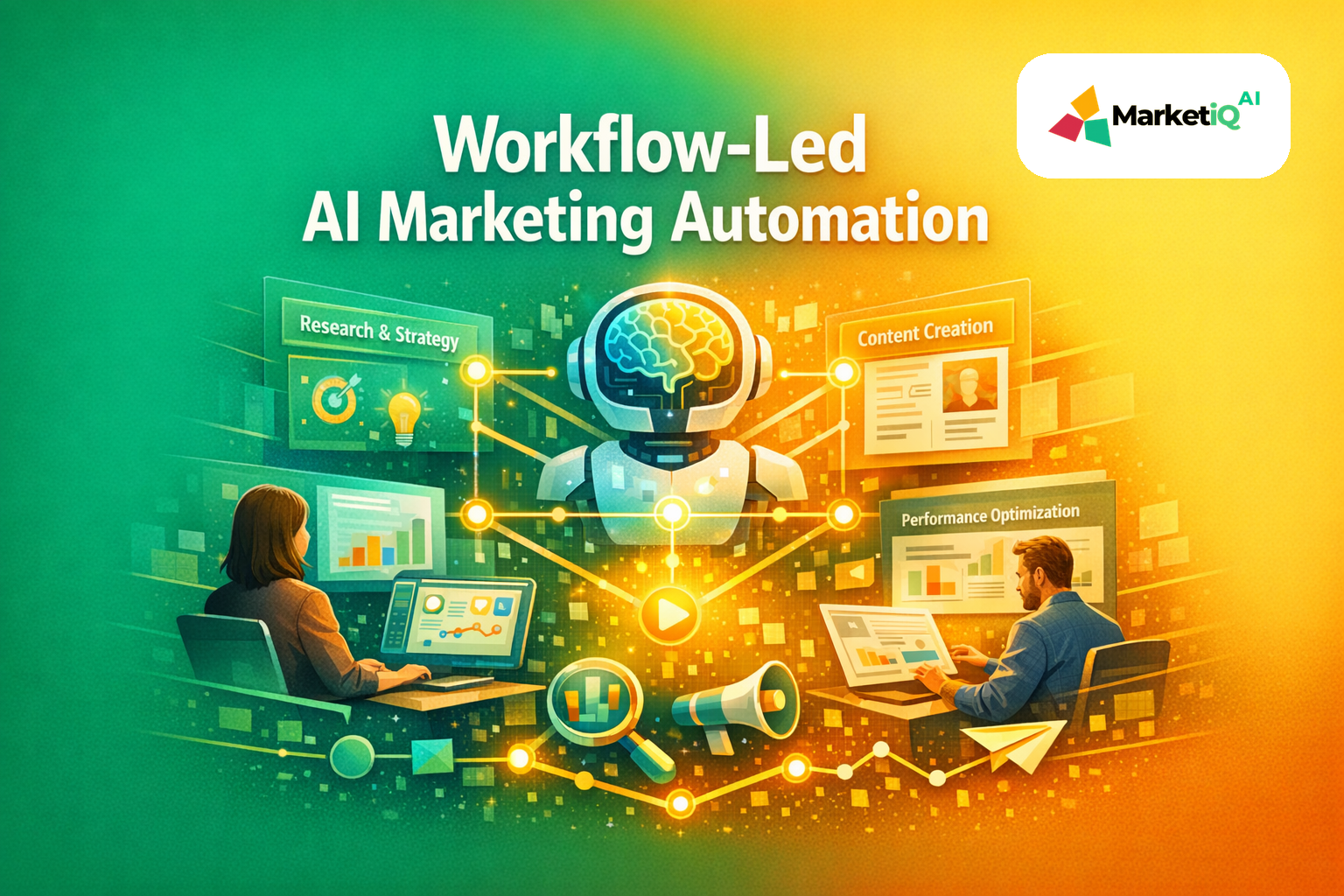
AI Marketing Automation: Tools, Workflows and Benefits
AI marketing automation is often presented as a faster way to produce individual assets: write a post, generate an email, summarize a report or create an ad variation.
That is useful—but it is not the main value.
The real advantage appears when AI connects the entire marketing workflow: research informs strategy, strategy informs content, approved content gets published, and performance data improves the next cycle.
For lean marketing teams, this changes the operating model. Instead of coordinating disconnected tools and manual hand-offs, the team manages a controlled system that continuously turns market signals into campaigns and learning.
What Is AI Marketing Automation?
AI marketing automation uses artificial intelligence to execute, coordinate or improve marketing activities across a connected workflow.
Traditional automation follows predefined rules. For example, a form submission can trigger an email. AI marketing automation can add interpretation and decision support: analyze customer language, identify themes, develop messaging, create campaign assets, recommend channels and adjust future activity based on results.
The distinction matters. Automating isolated tasks creates more output. Connecting tasks creates a marketing loop.
A complete AI marketing automation workflow typically includes:
- Market and customer research
- ICP and persona development
- Positioning and messaging
- Campaign and channel planning
- Content and creative production
- Human approval and governance
- Multi-channel publishing
- Performance analysis and attribution
- Experimentation and optimization
The objective is not fully hands-off marketing. Effective automation requires data access, permissions, brand context and explicit approval gates. Humans should remain accountable for strategic decisions, sensitive claims and final publication where appropriate.
How AI Marketing Automation Works
A workflow-led system moves through connected stages rather than asking a team to prompt an AI tool repeatedly.
1. Research creates the evidence base
The system collects relevant market signals, customer language, competitor context and channel performance. That information becomes a working market map instead of remaining scattered across documents, browser tabs and analytics platforms.
2. Strategy turns evidence into direction
AI agents can use the research to support ICP definition, positioning, messaging, campaign themes and channel priorities. The team reviews the recommendations, corrects assumptions and approves the direction before production begins.
3. Brand context guides production
Content generation works better when the system understands the company’s audience, voice, offers, proof points and restrictions. A shared knowledge layer—such as MarketiQ AI’s Brand Brain—reduces repeated briefing and keeps different assets aligned.
4. Approval gates control execution
Not every step should run automatically. Teams can define where review is required: campaign strategy, claims, creative, budget allocation or final publishing. The workflow should pause transparently at those gates rather than obscure what the system is doing.
5. Publishing distributes approved work
Once approved, publishing workflows can schedule and distribute content across connected marketing channels. This reduces the operational gap between “ready” and “live.”
6. Optimization closes the loop
Performance data should feed back into planning. Results from campaigns, experiments and attribution inform the next research and strategy cycle. Without this feedback loop, automation only accelerates repetition.
Benefits of AI Marketing Automation for Marketing Teams
More execution capacity
A lean team can cover more of the marketing function without manually coordinating every research task, brief, draft, calendar update and report. This is especially useful for companies where one to five marketers are expected to support strategy, content, demand generation and analytics at the same time.
Faster campaign cycles
When research, planning, production and publishing operate in one workflow, campaigns can move from idea to approved execution with fewer hand-offs. The benefit is not simply speed. Faster cycles create more opportunities to learn and adjust.
Lower operating effort
Disconnected tools create recurring coordination work: exporting data, rewriting briefs, checking brand consistency, copying campaign details and assembling reports. AI marketing automation can reduce that administrative load by keeping context connected across stages.
More consistent messaging
A central source of brand and product context helps maintain consistency across posts, emails, landing-page copy, campaigns and creative concepts. Human review remains important, but reviewers spend less time correcting preventable inconsistencies.
Sharper performance learning
A closed-loop system connects activity to feedback. Rather than treating analytics as a monthly retrospective, teams can use performance and attribution signals to influence what gets researched, created and tested next.
Better visibility for leaders
Founders and marketing leaders can review the decisions, outputs, approvals and performance signals inside one operating layer instead of reconstructing progress across multiple systems.
Key Features and AI Marketing Automation Workflows
The most valuable features are the ones that connect stages of work.
A research-to-campaign workflow might begin with agents analyzing customer and market inputs. Strategy agents then produce an ICP, positioning direction and campaign plan. Composer and creative agents use approved brand context to produce the required assets. Planning and publishing agents prepare the distribution schedule. Analytics and experimentation agents monitor performance and recommend adjustments.
A practical workflow could look like this:
- Define the business objective and conversion event.
- Load product, audience, brand and compliance context.
- Research customer language and relevant market signals.
- Approve the ICP, message and channel strategy.
- Generate campaign assets from the approved direction.
- Review claims, creative and calls to action.
- Publish across the selected channels.
- Monitor engagement, leads and revenue-linked signals.
- Feed results into the next campaign decision.
MarketiQ AI is designed around this operating model. Its AI CMO and 45 AI agents support research, strategy, creation, publishing and optimization through 26 optimization loops. The product is free to start, allowing teams to evaluate the workflow before expanding its role in their go-to-market execution.
How to Choose and Implement an AI Marketing Automation Tool
Start with workflow coverage, not the number of isolated features.
Ask whether the tool can connect research to strategy, strategy to production, production to publishing and performance back to planning. Then evaluate the control layer: Can your team define permissions? Can approval-gated steps pause clearly? Can humans edit outputs and override recommendations? Can the system preserve brand and product context?
Integration also matters. A tool should work with the systems and channels your team already uses where possible. The goal is to create a more coherent operating layer—not force an immediate replacement of every existing tool.
For implementation, begin with one repeatable workflow. A weekly content cycle, campaign launch process or performance review is usually easier to govern than an attempt to automate the entire marketing function on day one.
Use this sequence:
- Document the current workflow and its hand-offs.
- Identify the highest-cost manual bottleneck.
- Connect only the data sources and channels required for that workflow.
- Define brand rules, permissions and approval gates.
- Run the workflow with human review.
- Measure cycle time, output quality, approvals and performance signals.
- Expand only after the process is reliable.
AI Marketing Automation Best Practices and Limitations
Treat AI marketing automation as governed autonomy. Give the system enough context to make useful recommendations, but do not grant permissions without clear boundaries.
Keep humans responsible for positioning, legal or sensitive claims, budget decisions, customer commitments and final approval where risk warrants it. Review the inputs as well as the outputs: poor data, outdated product information or incomplete attribution can produce confident but weak recommendations.
Avoid automating a broken workflow. If objectives are unclear, ownership is missing or conversion tracking is unreliable, AI will not solve the underlying operating problem. It may simply produce more activity around a bad process.
Also avoid measuring success by volume alone. More posts, emails or campaign variations do not automatically create better marketing. Track execution speed, quality, learning velocity and business outcomes together.
The central takeaway is simple: AI marketing automation becomes valuable when it connects the loop, not when it multiplies tasks.
For lean B2B SaaS teams, the next step is to map one campaign workflow from research through optimization, add explicit approval gates, and test whether a connected AI operating system can reduce hand-offs while improving the quality of learning.
Ready to see what an always-on GTM workflow looks like? Start with MarketiQ AI and build your first connected marketing loop.
- #AI
- #Marketing
- #Automation
- #Workflows
- #Tools
This article describes practices and observations; it is not a promise of rankings, deliverability or revenue. Verify cited sources and their dates before making decisions.
Related reading
- 1Best Autonomous GTM OS for Lean B2B StartupsLinked from this article
- 2Jasper and Copy.ai Alternatives Beyond ContentLinked from this article
- 3The Operating Loop Decision for Lean B2B SaaS TeamsLinked from this article